
From Life Plan to Real Life: How Community Habilitation Works in Practice
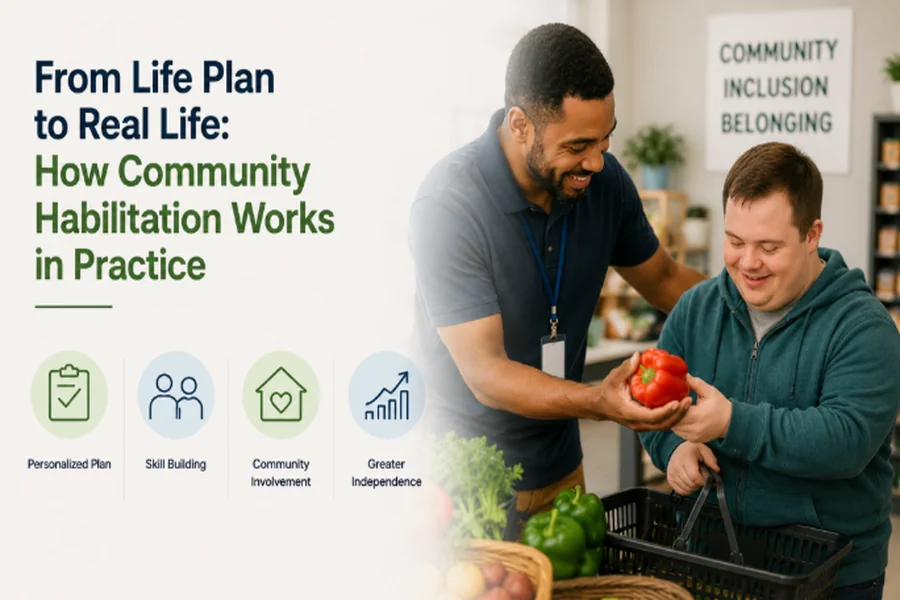
Most families who go through the OPWDD enrollment process come out the other side with a Life Plan and a list of authorized services they don’t fully understand yet. OPWDD community habilitation tends to be one of them. The name tells you roughly what it is. What it doesn’t tell you is what actually happens once a support worker shows up at the door, what a typical session looks like, or how you’d know whether it’s working. That gap between the document and the daily reality is what this article is about.
What the Life Plan actually sets up
A Life Plan is a record of goals. Someone who worked with the individual and their family sat down and documented what the person wants to develop, what they’re working toward, what kind of support they need to get there. It might say something like “improve independent cooking skills” or “develop the ability to use public transit without assistance.” These are real goals, and they’re supposed to drive what happens in a program.
The problem is that goals written in a document don’t automatically become skills in real life. That translation requires somebody to show up, consistently, and do the actual work of practicing those skills in the environments where they matter. That’s what community habilitation is.
A support worker is assigned to the individual and works with them one on one, at home or out in the community, on whatever the Life Plan has identified as the priority. Not in a classroom. Not in a facility. In the kitchen where the person actually cooks, on the bus route they actually need to use, in the neighborhood where they actually live.
What a session looks like in practice
This depends entirely on the person and their goals, which is sort of the point. But a few patterns come up often enough to be worth describing.
Cooking skills sessions tend to look like this: the support worker and the individual work through a recipe together, but the support worker isn’t doing the cooking. They might prompt the next step, or help the person read a label, or redirect if something starts to go wrong. Over repeated sessions, the prompts decrease. The goal isn’t a meal. It’s the person being able to make that meal without help.
Transit training usually starts with riding the route together. Then the individual leads. Then the support worker rides separately and observes from a distance. Eventually they’re not there at all. The same progression applies to shopping, banking, or any other community activity the person is working toward.
What’s consistent across all of these is the gradual withdrawal of support as the person’s competence builds. A session where the worker does most of the work is not a successful session. It’s a starting point.
Why one on one matters
Group programs are good at some things. Peer contact, social practice, shared activities. Community habilitation is good at something different: precision. Because it’s one person working with one other person, the support can be calibrated in a way that group settings can’t match.
If someone is having a harder day and needs more scaffolding, the session adjusts. If they’ve made a breakthrough and are ready for less support, the session adjusts. There’s no curriculum to stay on, no pace set by the group. The session is about this person, today.
This calibration also happens over time. A support worker who has worked with the same person for months knows things about them that a new worker doesn’t: what triggers frustration, what time of day they’re sharpest, which approaches tend to work and which don’t. That knowledge accumulates, and it makes a real difference in outcomes.
Gateway Counseling Center assigns community habilitation workers with continuity in mind. The same worker stays with the same person over an extended period, which sounds like a small detail but changes what’s possible. Trust between a support worker and an individual isn’t automatic. It builds through repeated contact, and the work goes better once it exists.
How community habilitation fits with other services
Community habilitation on its own addresses individual goals in individual settings. Combined with other programs, the effect compounds.
Someone who attends a group day program a few days a week gets peer contact and structured group activity there. Community habilitation fills in the specific skill goals that need one on one attention. Family support services address what happens at home. These three together cover more ground than any one of them does alone, and when the provider coordinates across them, there’s less duplication and more continuity.
This is one reason families tend to benefit from providers who offer multiple service types. Not because a single provider is always better, but because coordination across services is easier when the people delivering them are talking to each other.
What families should ask before enrolling
A few questions are worth raising with any community habilitation provider before committing:
How long do support workers typically stay with the same individual? High turnover is a real problem in this field, and some providers manage it better than others.
How are sessions documented, and how does the family get updates on progress? If a provider can’t answer this concretely, that’s worth noting.
How do community habilitation goals connect to the rest of the individual’s programming? If the provider offers other services, do the teams communicate?
Can families observe sessions, at least early on? Some people take time to adjust to a new worker, and seeing the dynamic firsthand can help families understand what’s working.
If you want to see how Gateway approaches these questions in practice, they offer free 30-minute tours at their New York City locations. The intake team is reachable at Intake@gccnyc.org or by phone at (718) 885-4986.