
Choosing Surf Lessons That Match the Way You Learn
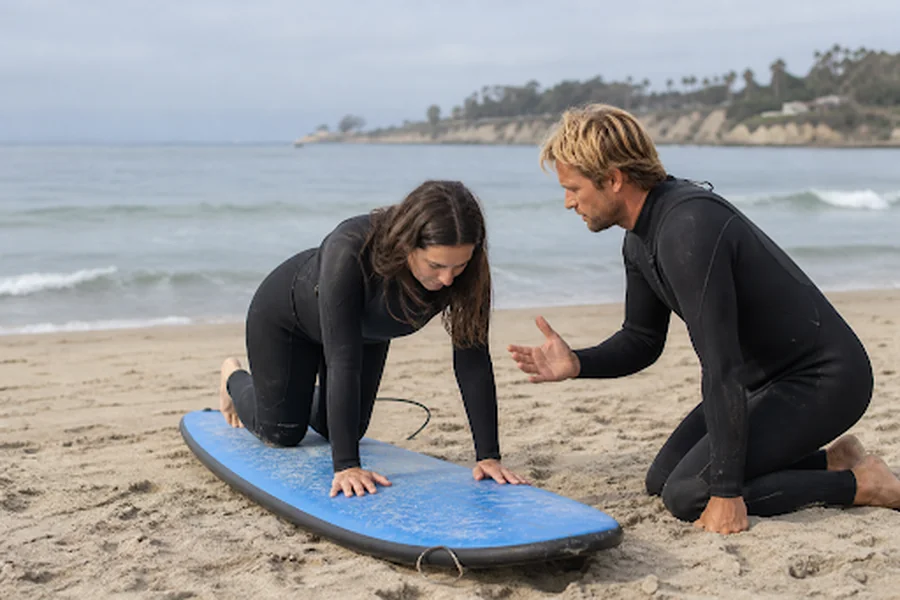
Well-planned private surf lessons account for the fact that two people can watch the same waves and need completely different instruction. One may be comfortable swimming in open water but struggle with the pop-up. Another may be athletic on land and freeze when a wave lifts the board. Useful coaching starts with those differences instead of forcing every student through an identical script.
The main booking choices are usually private, small-party, and group formats. Each can work well, but they create different amounts of coaching time, social energy, and independence. Understanding those tradeoffs helps beginners spend their first session learning rather than wondering whether they chose the wrong option.
What to expect from a surf instructor
A professional instructor does more than push a board into a wave. The session should begin with an assessment of swimming confidence, previous surfing experience, injuries, and goals. On the beach, the instructor explains the conditions, demonstrates safe board handling, and breaks down paddling, the pop-up, and stance. Once the student enters the water, those general instructions become specific corrections.
Good feedback is short enough to use on the next attempt. “Move your back foot two inches” is more helpful than a long speech delivered while another wave approaches. The coach should recognize when the problem is timing, body position, board direction, or simple fatigue. Encouragement matters, but it should not replace precise observation.
Local knowledge is equally important. Wind, tide, swell angle, and crowd levels can change the lesson area. An instructor familiar with nearby breaks can choose a place that suits the student instead of insisting on one location because it is convenient. The decision may mean driving farther from town, but a gentle, consistent wave often produces more practice and less frustration.
When private surf lessons offer the most value
One-on-one coaching is a strong choice for a first-time surfer who feels anxious in the ocean, a child who needs close supervision, or an intermediate rider with a clear technical goal. The instructor can set the pace around one person and spend more time correcting repeated habits. There is also less waiting between attempts.
Private instruction does not mean the student avoids independence. A thoughtful coach gradually reduces assistance as the student learns to identify a suitable wave, turn the board, paddle, and stand. The purpose is not to manufacture one successful ride for a photograph. It is to help the surfer understand why that ride worked.
Santa Barbara Surf School describes a lesson that starts with ocean safety, board position, paddling, pop-up technique, and stance before moving into the water. Equipment is included, and the company selects teaching locations according to conditions. Travelers can review current session details and availability on the official lesson page.
A private format can also make sense for someone returning after an injury or a long break. Tell the instructor what feels uncertain. The lesson can emphasize controlled movement and wave selection instead of chasing a high number of rides.
What happens during beginner surf lessons
Beginners usually make better progress when the session follows a simple order. First comes ocean awareness: where waves are breaking, how water is moving, and which area the instructor wants the student to use. Next comes equipment handling and a dry-land rehearsal. Only then does the student enter the water.
The first goal is often to ride broken whitewater while maintaining a stable position. This gives the learner time to feel the board accelerate without also having to select and catch an unbroken wave. As balance and timing improve, the instructor can add more independent paddling and introduce wave judgment.
A realistic beginner session might include:
* Carrying and positioning the board safely;
* Lying in the correct paddling position;
* Looking forward rather than down during the pop-up;
* Placing the feet along the center line;
* Bending the knees without folding at the waist;
* Falling away from the board and protecting the head;
* Returning to the starting area without crossing another surfer’s path.
Not every student stands on the first attempt. That is normal. Progress may be learning to keep the board straight, catching a wave with less assistance, or recognizing the right moment to paddle. A good instructor points out those gains instead of treating standing as the only result that counts.
The social side of group surfing lessons
Groups bring a different kind of motivation. Friends and family members can celebrate each other’s rides, laugh at awkward starts, and share the memory afterward. For celebrations or company activities, that atmosphere may be the main reason to book.
The limitation is divided attention. Students should expect periods of practice while the instructor works with someone else. This can be productive when everyone has learned the safety rules and knows where to wait. It becomes a concern when one coach is responsible for too many people or for a group with sharply different abilities.
Ask how instructors are assigned as the party grows. Multiple coaches allow beginners to receive hands-on help while stronger surfers work on positioning or turns. Also clarify whether “group” means only your own party or a mixed session with other customers. Both formats are valid, but they are different products.
Why adult surf lessons are not just children’s classes with older students
Adults often arrive with more caution, less flexibility, and a stronger fear of looking foolish. They may also bring useful strengths: patience, body awareness, and the ability to understand technical explanations. Instruction should respect that combination.
An adult beginner benefits from a warm-up, a stable board, manageable goals, and permission to rest. The coach can adapt the pop-up for mobility while still teaching a position that works in the water. People do not need to be exceptionally fit to try surfing, but they should be honest about swimming ability and health concerns.
For many adults, the best first goal is not standing for a long ride. It is becoming calm enough to repeat the process: position the board, paddle with purpose, feel the wave, and move without rushing. Confidence grows from recognizable steps.
A practical booking checklist
Before reserving, compare the full lesson rather than price alone. Confirm the duration, participant-to-instructor arrangement, equipment, meeting-point process, cancellation or rescheduling policy, minimum age, and swimming requirement. Ask whether the school changes beaches when conditions are unsuitable.
Then consider your own priority. One-on-one instruction suits concentrated feedback or extra reassurance. A closed small-party lesson works when learning with a partner matters. A larger group fits a shared activity when the provider can supply enough instructors.
The right format will not remove every awkward moment. Falling, missing waves, and forgetting a step are part of learning. What good instruction changes is the meaning of those moments: each becomes information for the next attempt, not proof that surfing is beyond reach.