
How Do Power Plants Keep Their Water Clean?
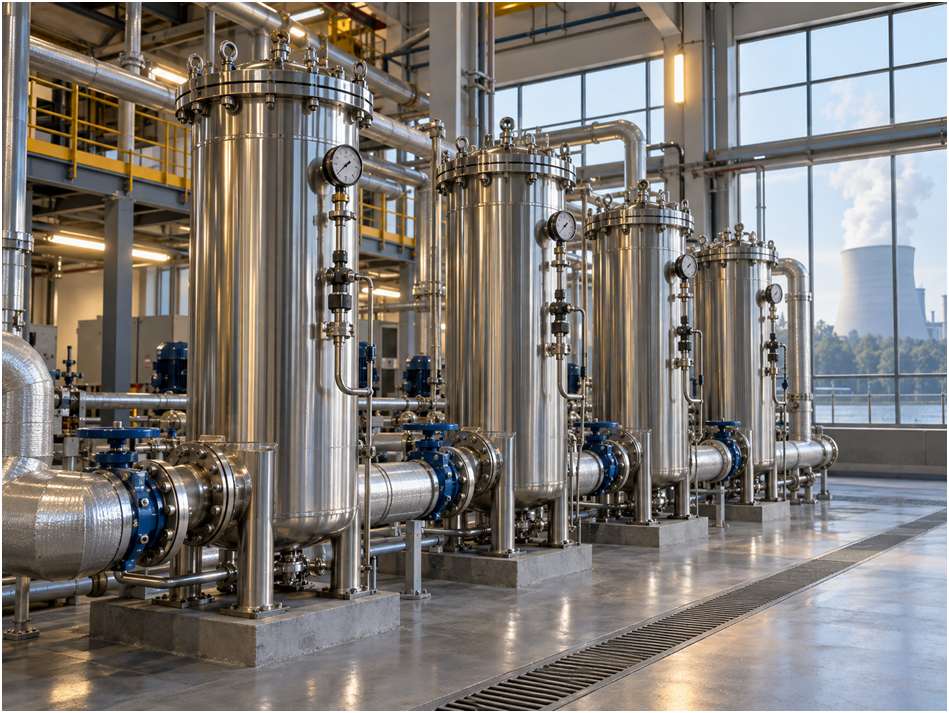
Flip a light switch and there is a good chance the electricity started as boiling water. Coal, gas, nuclear, biomass and many solar thermal plants all work the same basic way: heat water into high-pressure steam, spin a turbine with it, then cool the steam back into water and send it round again.
That loop has a surprisingly strict requirement. The water has to be extraordinarily clean, far cleaner than the water that comes out of your tap. Here is why, and how plants manage it.
Why dirty water is such a problem
Every time water travels through pipes, pumps and heat exchangers, it picks up tiny amounts of whatever it touches. Mostly that means iron particles from steel pipework, along with silica, suspended solids and fine colloids.
In a kettle, that would not matter. In a boiler running at extreme temperature and pressure, it matters a great deal. Particles settle on the inside of boiler tubes and form deposits that act like insulation. The plant has to burn more fuel to push the same heat through, and the tubes run hotter than they were designed to.
Particles that make it into the steam end up on turbine blades, where they build up and erode the metal. Over time, both problems lead to corrosion, unplanned shutdowns and repairs that can take a generating unit offline for weeks.
Condensate polishing: the cleaning step most people never hear about
After steam passes through the turbine, it is cooled back into water called condensate. Before that condensate can return to the boiler, it goes through a stage the industry calls condensate polishing.
Filters remove particles, and in many plants ion exchange resins then remove dissolved impurities. The goal is to bring the water back to boiler feedwater standard so it can be reused rather than thrown away.
Plants use several types of filter here. Pleated cartridges trap fine particles on their surface. String wound cartridges, made from yarn wrapped around a core, trap heavy iron loads through their depth. High flow cartridges are larger elements built to handle big volumes, and a single 40-inch high flow element can replace 30 to 35 standard cartridges.
Start-up is the dirtiest moment
One detail surprises people. The worst water a plant sees is not during normal running but when a unit starts up after maintenance or a shutdown.
While the system sits idle, the inside of the pipework corrodes, and all of that loosened iron flushes through at once when water starts moving again. Plants often use start-up filters with coarser ratings to handle that surge, then switch to finer operating filters, typically in the 1 to 10 micron range, once conditions settle.
It is not only water
Clean fluids matter elsewhere in the plant too. Turbines and generators rely on lubricating oil to protect their bearings, and hydraulic fluid to operate control valves and governors. A few hard particles in either can score a bearing or jam a valve.
Cooling water circuits need filtering to stop heat exchangers clogging, and air intakes on gas turbines are filtered to keep dust out of the compressor.
How do they know the water is clean enough?
Plants do not guess. The steam-water loop is monitored continuously by online analysers that sample the water at several points and report to the control room around the clock.
Conductivity is the workhorse measurement, because dissolved impurities raise it almost immediately. Dissolved oxygen is tracked closely too, since oxygen drives corrosion. pH, silica and sodium are measured as well, and iron is monitored at levels so low they are expressed in parts per billion.
The filters report on themselves in a simpler way. Gauges on each filter housing measure the pressure difference between the water going in and the water coming out. As a cartridge fills with the particles it has captured, that difference rises. When it reaches a set point, the cartridges are changed. It is a straightforward signal, and it means filters are replaced when they are actually full rather than on a guess.
Chemists also take grab samples by hand and test them in an on-site laboratory, which checks that the online instruments are reading correctly.
Why this matters beyond the plant
Good filtration is also an environmental story. A plant that recycles its condensate uses far less fresh water and discharges far less. Many facilities now aim for zero liquid discharge, where effectively all process water is treated and reused on site.
It is a cost story as well. Fewer outages, longer equipment life and less fuel burned per megawatt hour all feed into the cost of generating electricity. Modern power plant filtration is designed around those savings: bigger filter elements mean fewer change-outs, smaller housings and less maintenance time.
None of this is visible from outside the fence. But the next time you see a cooling tower on the horizon, it is worth knowing that somewhere inside, a row of filters is working around the clock so the water in that steam loop stays clean enough to keep the lights on.