
Broad Spectrum Where Precision Matters
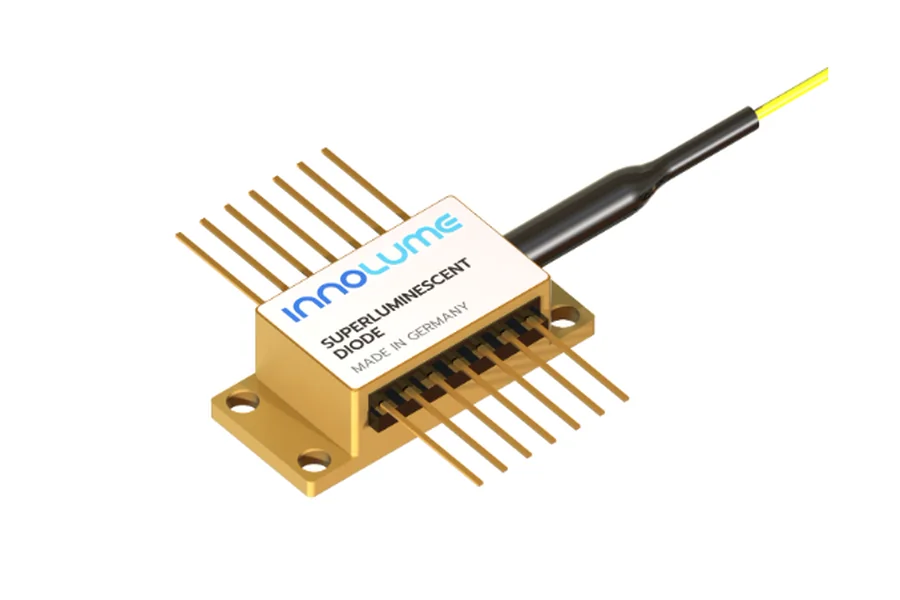
Not every optical system needs a laser. Some applications require a source that combines high spatial coherence with a much broader optical spectrum and avoids the narrow spectral behavior associated with lasing. This is where superluminescent diodes occupy a distinct place between conventional LEDs and laser diodes.
For systems built around broadband emission, superluminescent diodes generate amplified spontaneous emission while avoiding the optical feedback required for laser action. A tilted waveguide and anti-reflective coatings suppress residual reflections, helping reduce spectral ripples. The resulting combination of broad emission and high spatial coherence makes SLDs suitable for coupling into single-mode optical fibers.
Why Broadband Emission Changes the Picture
The spectral characteristics of an SLD directly influence how it performs in an optical setup. Its peak wavelength and emission intensity depend on the active material composition and injection current, while the width of the spectrum affects coherence length. A broader spectrum can therefore be useful in applications where low coherence and wideband emission are important.
Unlike a conventional laser diode, an SLD is designed for high single-pass amplification of spontaneously emitted light along the waveguide. The absence of significant optical feedback prevents the device from developing laser oscillation. This operating principle is supported by carefully designed waveguides and anti-reflective facet coatings with reflectivity below 0.001% in Innolume GmbH’s SLD technology.
Matching the Source to the Application
The right SLD depends on more than its nominal wavelength. Output power, spectral bandwidth, ripple level, polarization characteristics and package configuration all affect how the component can be integrated into a larger photonic system.
Typical considerations include:
- mean wavelength and required spectral bandwidth;
- output optical power and forward current;
- spectral ripple and polarization extinction ratio;
- fiber type and coupling configuration;
- package format and additional monitoring options.
Innolume’s published SLD portfolio illustrates how widely these parameters can vary. Its listed devices include wavelengths such as 830, 980, 1000, 1030, 1055, 1060, 1090, 1120, 1140, 1145 and 1250 nm, with different combinations of bandwidth and output power. For example, the 1060 nm range includes devices with 20 nm bandwidth and output power up to 120 mW, while another 1055 nm model offers a 120 nm bandwidth.
From Optical Source to Integrated Component
Packaging is essential when an SLD is integrated into a complete system. Innolume GmbH offers 14-pin modules with PM or HI fiber options, chip-on-submount and C-Mount configurations, as well as TO cans and selected fiber-coupled versions with monitor photodiodes. Its SLDs support applications such as fiber sensing, spectroscopy and instrumentation, with customizable wavelength and spectrum width. This range of configurations helps meet specific spectral, power and integration requirements.
Broad Spectrum Where Precision Matters
Broad-spectrum solutions are essential in industries where accuracy, reliability, and effectiveness matter. Whether applied in healthcare, technology, agriculture, or other specialized fields, broad-spectrum approaches provide wider coverage while maintaining consistent performance.
However, broad coverage does not mean precision should be compromised. Selecting the right solution requires understanding specific needs, evaluating available options, and ensuring the results meet established standards. By combining broad-spectrum capabilities with targeted precision, businesses and professionals can improve efficiency, reduce unnecessary risks, and achieve better outcomes.
Ultimately, the best approach balances comprehensive coverage with accuracy, delivering reliable results where precision matters most.