
How Does Speed Affect a Car Accident?
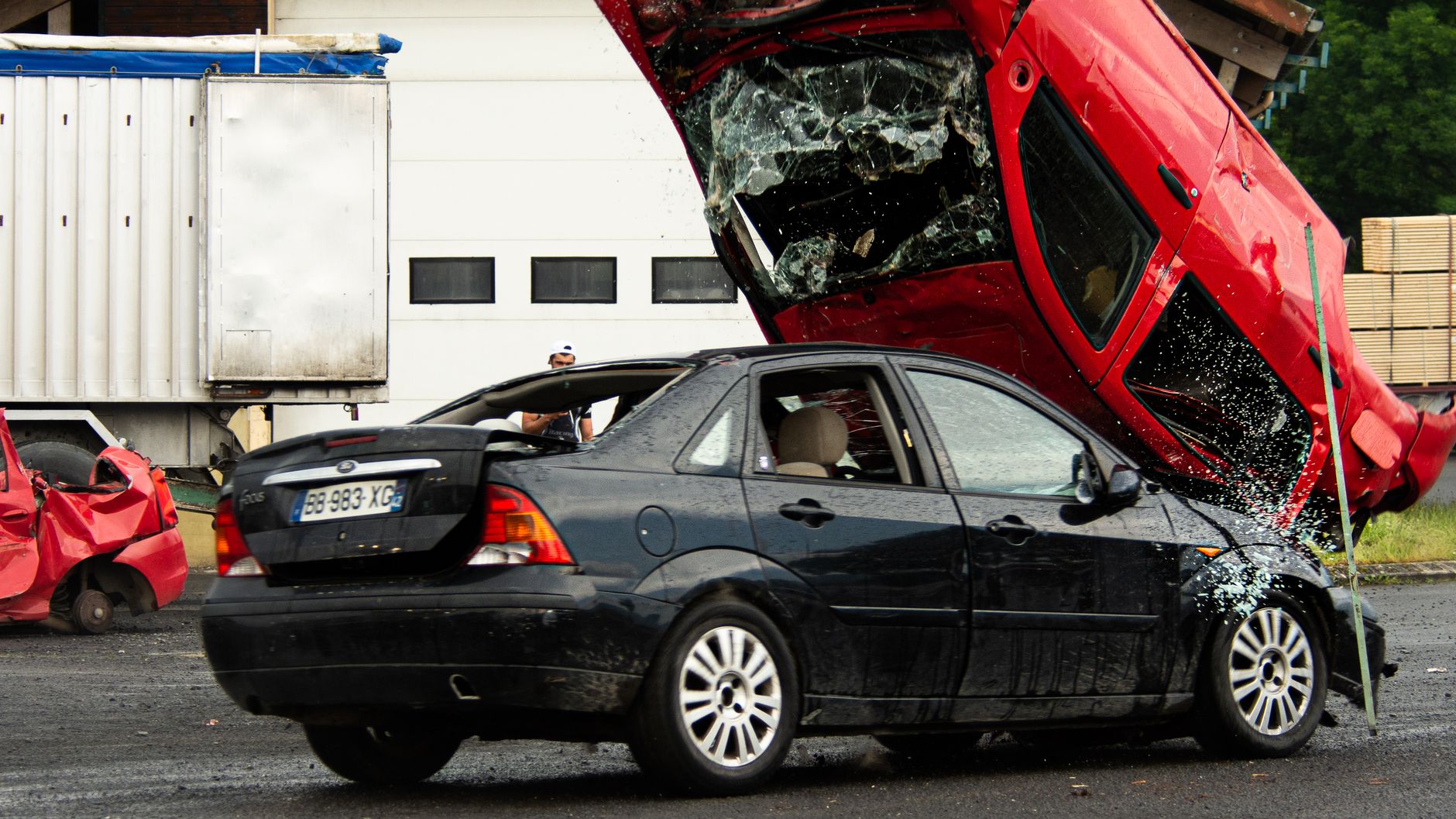
Speed significantly affects car accidents by raising the chances of collisions and the severity of injuries. For every 10 mph increase in speed, the risk of dying in a crash doubles. Additionally, increasing the speed from 60 mph to 80 mph quadruples the risk of a fatal crash.
Higher speeds contribute to accidents in several ways:
- Increased Stopping Distance: Longer distances are needed to stop the vehicle after a driver notices danger
- Reduced Reaction Time: Slower responses to changing road conditions, such as rain or ice.
- Greater Risk of Loss of Control: Higher speeds make it harder to keep control of the vehicle.
- More Severe Injuries: Increased crash energy leads to more serious injuries.
Speeding was a contributing factor in 29% of all traffic fatalities in 2024, showing how prevalent and dangerous it is in accidents.
The Physics of Speed and Collision Force
Kinetic energy is calculated as ½mv², and it means that even modest increases in travel speed result in exponentially greater collision forces. At high speeds, this energy transforms into a devastating impact, leading to serious injuries and increased property damage.
How Kinetic Energy Increases With Velocity
Kinetic energy increases quadratically with velocity, as described by the formula ½mv². When a vehicle travels at twice its original speed, its kinetic energy quadruples. Tripling the speed increases the kinetic energy by a factor of nine.
As a result, excessive speed significantly increases injury severity in collisions, with crashes at 40 mph and higher having a 20% survival rate.
Speed’s Effect on Driver Reaction Time
Increased speed reduces a driver’s reaction time to hazards. For every 1 km/h increase in speed, reaction time can decrease by up to 10%, giving less time to brake or steer.
This decrease in reaction time worsens injury severity, as the driver has less time to take evasive actions such as swerving or braking.
Why Reduced Reaction Time Leads to More Severe Crashes
Reduced reaction time can lead to more severe crashes because a speeding vehicle travels farther before the driver can respond, making it harder to avoid a collision. This increases the risks involved, often leading to serious injuries like broken bones and concussions. It also increases stopping distance and reduces overall road safety.
Stopping Distance and Speed
As a vehicle goes faster, the distance it needs to stop grows significantly. On wet roads or in poor weather, this stopping distance becomes even longer, making it harder to avoid speed-related accidents even when following the posted speed limits.
How Speed Dramatically Increases Braking Distance
Speed increases braking distance due to its quadratic relationship with velocity. Doubling your speed quadruples your braking distance:
- 2 times the speed means 4 times the braking distance
- 3 times the speed means 9 times the braking distance
For example, at 30 mph, the stopping distance is about 23 meters, which becomes 74 meters at 60 mph.
What Road and Weather Conditions Make Stopping Even Harder
Adverse conditions can make stopping more challenging by reducing friction on the road surface. Key factors include:
- Wet roads can double the stopping distance
- Ice can triple the stopping distance
- Snow or ice can increase it up to 10 times
Slower speeds are important for road safety in these conditions.
How Speed Affects Injury Severity in Car Accidents
Speed affects the severity of injuries in car accidents. More forceful impacts place greater stress on the human body, often resulting in serious or fatal injuries. Even in low-speed collisions, victims can still suffer substantial harm. Common injuries in high-speed collisions include broken bones, spinal damage, and internal trauma, all of which can greatly affect the recovery process.
Studies show that the fatality risk increases as speed goes up. For example, a car traveling at 60 mph gives pedestrians a 90% chance of being killed.
Common Injuries Sustained in High-Speed Collisions
High-speed collisions often cause severe injuries such as whiplash, traumatic brain injuries (TBIs), fractures, and internal injuries. Each year, TBIs alone lead to 50,000 deaths, showing the importance of responsible driving speeds for road safety.
Why Low-Speed Collisions Still Cause Serious Harm
Even at low speeds, car accidents in residential areas and school zones can lead to serious injuries, especially if pedestrians are involved. Victims may face ongoing medical bills and lost wages from missed work.
Acknowledging that no crash is truly minor is important for ensuring road safety.
How Injury Severity Influences the Recovery Process
Serious injuries sustained in a car crash can significantly affect the recovery process. They often require:
- Longer hospital stays
- More intensive medical treatments
- Extensive rehabilitation services
The psychological impact of serious injuries can also delay recovery.
Vehicle Safety Features and Their Limits at High Speeds
Vehicle safety features can reduce the risk of fatal crashes, but they have limitations, especially at high speeds. Here are some key limitations:
- Autonomous Emergency Braking (AEB): Can reduce rear-end collisions by 50%, but it may not fully protect occupants in extreme circumstances.
- Forward Collision Warning (FCW): Can help reduce injuries by 20%, but its effectiveness decreases at higher speeds.
- Blind Spot Monitoring (BSM): Can decrease lane-change crashes by 14%, but it may not prevent all incidents, particularly in severe impacts.
These features are valuable tools, but they should not be relied upon as the sole means of ensuring safety.
How Airbags and Seat Belts Perform During High-Speed Crashes
Airbags and seat belts work best when used together, though their effectiveness decreases at high speeds. Data on airbags show:
- Airbags reduce the risk of fatal injury by 30% during frontal crashes.
- Side airbags decrease the driver’s risk of fatal injury by 37%.
When a Car’s Structural Integrity Fails at High Impact
At high speeds, crashes can significantly distort the frame rails, pillars, and crumple zones, affecting occupant protection. When damage impacts multiple crush zones, the vehicle’s structural safety measures are typically lost.