
How to Optimize Your Factory Layout for Seamless Material Flow and Minimal Bottlenecks
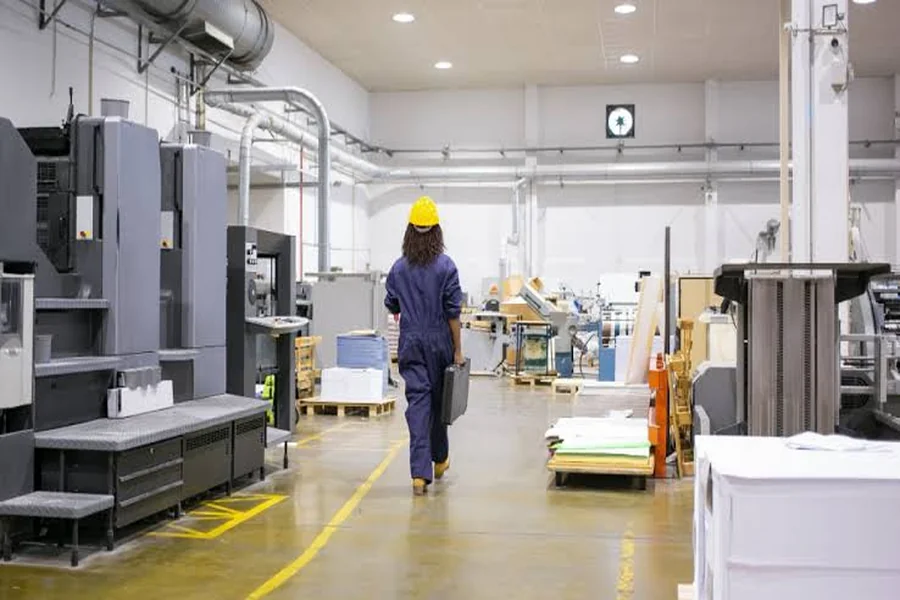
When things don’t flow your quality drops, your costs go up, your lead times stretch out, and your competitive advantage washes away on a flood of red ink. Fixing your flow – your materials’ ability to move through your factory without being stuck in inventory or delayed in queue – is something you have to get right if you’re going to stay in business.
Start With What’s Actually Happening, Not What You Think Is Happening
Almost all layout projects that we have ever seen go sideways start in the same way: the team locks itself in the conference room with a fresh CAD template, or – worse – redraws the floor plan using gut feel.
Before you do any of that, trace the course your highest-volume products physically take through your plant and warehouse. Not the path you wish they took. The one they actually do. Spaghetti diagrams will likely be your low-tech tool of choice here, and it’s for the same reason that they work best: they don’t lie. Print out your layout, then walk the path of a part and draw a line. And repeat. Do this for some representative parts/SKUs over an entire shift, and see which paths cross over one another, retrace steps, or detour in a countermarch. No one planned those accumulations of cattle tracks, but every plant has them, the consequence of years of forklifts being driven along the old maxim of “if there’s floor space, put ‘er there.”
While you are noting the part or the operator arrival and departure at every key point of handoff, also be noting the clock time. What you want to know is not just the route, but the lag. A good rule of thumb, albeit one that dates from the 1960s but that modern factories tend to confirm, is that parts on the floor of a conventional mass-production factory are actually being transformed only about 5 percent of the time they are inside the factory gate. The other 95 percent, they are either stopping or moving (or – and this happens more often than we care to admit – more likely waiting and then moving, which is the double whammy). If in doubt as to how this could apply to you, tally it up one day. Most factories working on an old-school ratio will pretty easily find they are in the ballpark.
Stop Organizing By Department and Start Organizing By Product
Many older factories are organized by function – all the lathes together whether you’re making car parts or door handles, welding in one bay, paint way over there – and for good reason, it feels efficient to put all the similar machines near each other. This layout is, unsurprisingly, called a process-oriented layout.
It’s not efficient. You’re fitting a square peg into a round hole by forcing every part to visit every department regardless of need, wait in line at every one it visits, and likely pay the travel cost of crossing the same square footage of factory floor multiple times because later work needed an earlier department.
Flow-based layout does pretty much exactly what it sounds like on the box: you take a representative product or family of products, group machines together that you use in common, and layout cells: contiguous floor regions that do everything from raw materials in to finished part out with minimal travel in between. This is the basic idea behind cellular manufacturing and the rise of the U-shaped work cell as the most recommended upgrade in lean factory redoes. The cell start and end are right next to each other so the operator (or the automated handoff) doesn’t travel unnecessary meters, and it makes one-piece flow (or at least much lower WIP) an achievable reality instead of a wistful aspiration.
The pretty concrete target here is reduce travel distance. Where you can have work flow straight through a sequence of operations, make it do so. Where you can’t because you have, for example, returned process pipes or just a super awkward building footprint, make a U shape of it. Every meter a part travels between operations is a meter where it’s not becoming a finished product yet and is probably at the root of that 95% waste figure.
Protect Your Bottleneck Before Anything Else
Not every station needs the same amount of your focus in a redesign. In every line, there’s a workstation that limits the total output of the entire process. The Theory of Constraints refers to this as the bottleneck, and the key idea is that your plant’s total throughput will never be higher than what that single workstation can achieve, no matter how efficiently all other stations operate.
Once you’ve found it – and it’s often relatively easy once you’ve observed the operations for a bit – the layout puzzle turns into: how do we prevent this station from ever sitting idle? That involves positioning upstream buffer stock and feeding equipment so the bottleneck never starves for material. It also means resisting the urge to speed up every other station, because pushing more WIP toward a constraint that can’t absorb it just creates a pile-up in front of it. This often requires some discipline on the part of the plant manager, who will see wasting cycle time as something of a sin. But the surest sign you’ve found the bottleneck is a station working around the clock that still never cuts the WIP inventory sitting in front of it.
Match The Equipment To The Volume, Not The Other Way Around
This is the part of the redesign process that is often the most difficult to define, but also tends to exert the most actual influence on whether your plant floor is a success. The specific material handling tech you want depends on the product and volume you’re trying to handle – a general suggestion to “put in some robots” doesn’t help much.
For low-volume, mixed-run production you don’t need much more than a well-planned, clean-sheet layout with neighboring cells close together and minimal obstructions in between. Parts and WIP can move that short distance most efficiently by gravity, or on a wheeled cart pushed by a worker. There’s no reason to use electricity to move stuff around if it’s just going to sit there for a while waiting for the next changeover.
On the other hand, if you’re dealing with a high-throughput line where you can’t afford for a station to shut down because the next one in the sequence ran out of parts or bulk material midway through the cycle, you want equipment that self-meters a steady supply to match the rate at which the downstream process pulls it. For getting bulk materials from point A to point B inside your factory, options like pneumatic feeders that automatically fill their hoppers from a central store can nearly pay for themselves just in operator cycle time gains, because one of the minor operator tasks you eliminate is standing there with a bucket loading powder over and over again all shift. It’s the exact kind of stop-start motion that could translate into seconds lost per unit across a whole shift. A slightly larger version of the same tech can automatically load thousands of parts into the buffer of the next stage to be processed while they’re being made, which is basically turning the keep-full hopper of the feeder on its side and running a conveyor belt in reverse underneath it.
Balance The Line To Takt Time
Takt time represents the demand rhythm of your customer, i.e. how often a unit must be produced to keep up with orders. A proposed layout may look physically efficient but can still lead to bottlenecks if operations are not in sync with this pace.
Assembly line balancing ensures that no operator or workstation is running significantly above or below the takt time. An unbalanced line manifests as WIP accumulating in front of the slowest workstation while operators wait for work in front of the fastest one.
This is worth revisiting any time your product mix shifts. A line balanced for one SKU mix can fall out of balance the moment volumes change or a new variant gets added, and that’s a common reason layouts that worked fine for a year suddenly start generating congestion.
Don’t Underestimate Aisles and Walkways
Many times this item is missing from the overall plant layout design. It’s easy to name the big things (park everyone within 100 yards of the time clock! Get eight boxes to flow from welding to paint to assembly in the right order!), but the devil’s in the details. Forklift traffic crossing pedestrian paths, narrow aisles that force material handlers to wait for each other, staging areas that spill into walkways – these create real delays and real safety hazards, and they’re often the easiest fix on this whole list.
Facilitate material delivery and staging with clear, dedicated aisles wide enough for two-way forklift traffic; take a step back to see where else fork trucks use the same aisles as people and separate them. Then consider how warehouse space is allocated and tracked. This should feel natural – no one wants a lift operator idling while they wait for a pedestrian to leave a cramped aisle corner before they can turn the corner themselves.
Test It Before You Move Anything, Then Lock It In
Once you have a proposed layout, don’t just start relocating equipment. Run it through a digital simulation or at a minimum a fresh value stream map to confirm the changes actually shorten the paths and reduce the waiting you measured earlier. Moving heavy equipment is expensive, and it’s a lot cheaper to find a flaw on a screen than after the concrete anchors are set.
After implementation, 5S becomes the maintenance layer. Clear markings for material locations, defined homes for tools and totes, and a standard for keeping flow lanes unobstructed all keep the layout you designed from drifting back into clutter within a few months. Layouts don’t stay optimized on their own – they need a discipline that protects them.
Finally, track the numbers that tell you if it worked: WIP levels, throughput, and order lead time. If those move in the right direction, the redesign is doing its job. If your product mix or seasonal volume shifts significantly, treat that as a trigger to revisit the layout rather than waiting for congestion to force the issue.
Flow problems rarely announce themselves clearly. They show up as missed ship dates, overtime that never seems to go away, and WIP that keeps creeping up no matter how hard everyone works. Fix the path material takes through your plant, and a lot of those symptoms disappear on their own.