
What is Actually on a Jewelry Maker’s Bench
A jewelry maker’s bench is not much to look at. It is a low wooden surface, scarred and pitted, with a wedge jutting from its front edge and a canvas apron underneath to catch stray filings. Scattered across it sit a saw frame, files, a torch, a loupe and pliers of several shapes. None of these objects photographs well, and none explains, on its own, what the work involves.
A tool-by-tool account of the saw, the bench peg, the loupe and the torch, and what each one demands from the hands that use them.
Each of those objects exists because a specific problem needed solving: holding metal still while it is cut, or shaping a ring so it sits evenly on a finger. The order in which a student meets them is roughly the order in which the work gets harder.
The first tools a jewelry making student is handed
A beginner starts nowhere near the decorative work. The starting kit is built around a jeweler’s saw, a set of needle files, a ring mandrel and a handful of pliers, each one chosen to teach control before speed. Held wrong, a saw blade snaps within seconds; held correctly, it becomes an extension of the wrist. Jewelry making schools such as Rome’s Accademia delle Arti Orafe, active since 1983, guide students individually from this first lesson onward. Hands-on practice with plain metal, long before gold or silver enters the picture, is what turns a beginner into an artisan who understands craftsmanship as something learned by hand.
Most of those first weeks are pure repetition. A student cuts the same straight line dozens of times, then files it flat, then cuts another. Blades break, files clog with metal, and almost nothing produced is worth keeping. What accumulates instead is a steady hand and a feel for how far metal will bend before it fails.
The bench and its peg: a shape that has barely changed
The wedge fixed into the bench’s front edge is called a bench peg, and it does a lot of work for something so small. A piece of metal rests against it while being sawn or filed, held steady by finger pressure rather than a clamp. Its height suits a seated worker, low enough for the elbow to do the steadying and high enough to keep the eyes close to the cut. Underneath, a canvas apron catches every filing, since gold and silver dust gets swept up and sent for refining rather than thrown away.
The Smith and Pepper factory in Birmingham’s Jewellery Quarter closed in 1981, and its owners locked the doors, leaving the workshop exactly as it stood on the last working day. The site is now preserved as the Museum of the Jewellery Quarter, run by Birmingham Museums. The hand tools and working methods preserved there would be immediately recognizable to a jeweler from ancient Egypt, Rome or medieval Europe. Little about the basic shape of the bench needed reinventing, because the problem it solves, holding metal still against a cutting or filing tool, has not changed either.
Saw, file and torch: the tools that remove and join metal
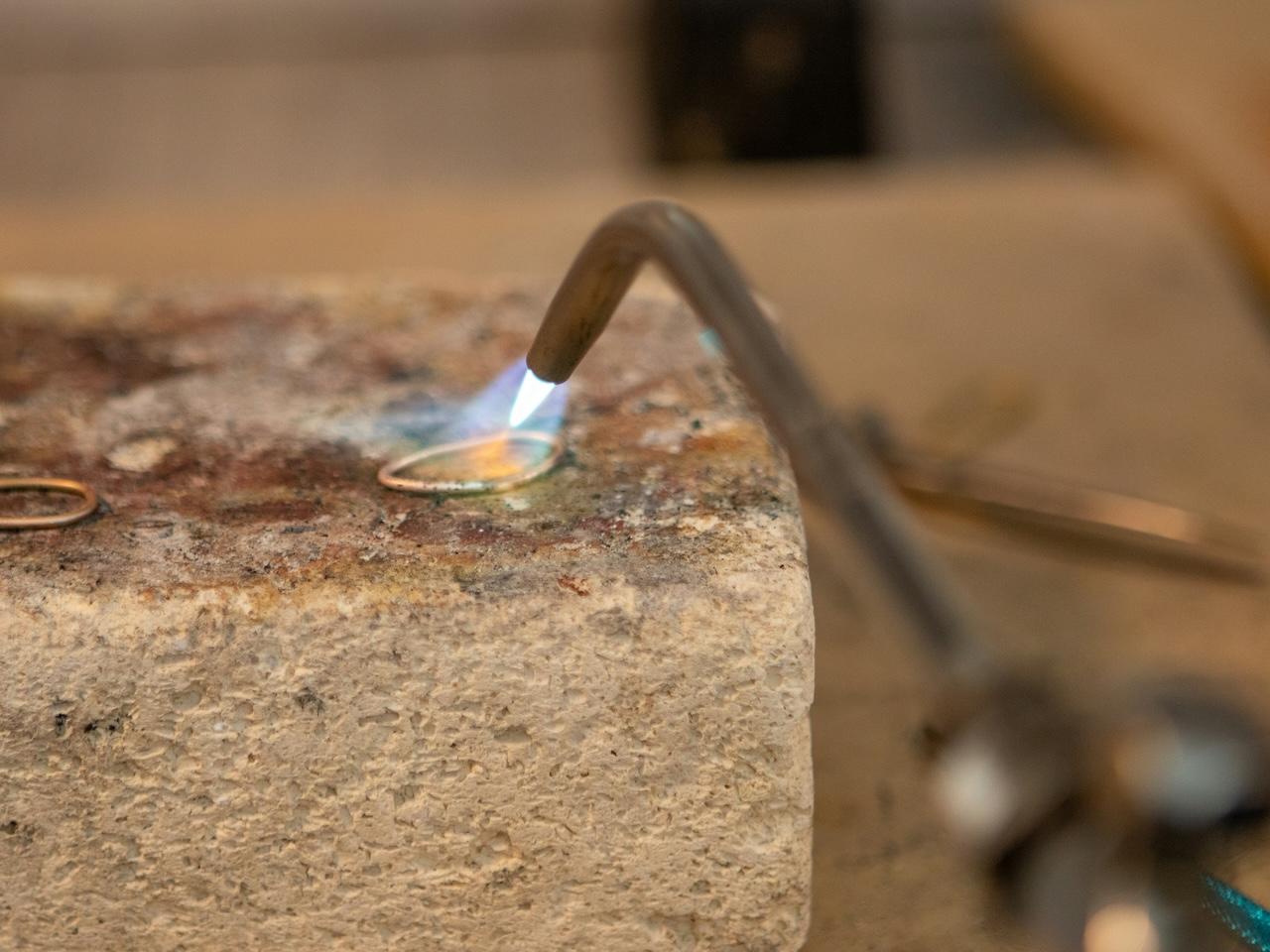
Cutting and joining metal rely on tools that look almost primitive next to a finished piece. The saw frame holds a blade thinner than a strand of hair, able to follow a curved pencil line without snapping. Files come in dozens of shapes, each suited to a particular groove or curve. A torch, fed by a small gas and oxygen mix, heats a joint until solder flows. The trick is reaching that point without melting the metal around it.
Soldering is where many beginners struggle longest, since the margin between success and a ruined piece is measured in seconds. Too little heat and the joint stays weak; too much and the metal slumps or discolors. Experienced jewelers judge the moment mostly by color, watching it shift from dull orange to a brief, telling flash.
Where the work gets small: loupes, gravers and finishing tools
Some of the most demanding work happens after the basic shape already exists. A loupe, a small magnifying lens worn against the eye socket, turns a setting or a solder seam into something large enough to correct. Gravers, small hardened blades set into wooden handles, cut the tiny grooves and beads that hold a stone in place, none of it visible in the finished piece.
Finishing tools, from felt wheels to fine abrasive papers, take a piece from structurally sound to wearable. A ring can be technically correct and still feel unfinished if a seam catches on fabric or a surface refuses to hold light evenly. Polishing removes the last trace of the process, leaving no sign of the saw, file or graver that shaped it. Clients notice the result and not the labor, which is one reason finishing takes longer than beginners expect.
What a working bench says about the trade
A bench used for years looks nothing like the tidy display cases in a shop window. Its surface is scarred, its peg worn smooth where thousands of pieces have rested, and its apron stained by decades of filings. Every mark on it corresponds to a task performed many times over, not to neglect. A jeweler looking at another bench can tell roughly what kind of work gets done there.
Tools change slowly in this trade, and mostly at the margins. Torches now run on cleaner gas mixtures, and loupes have better optics than the ones used a century ago. The basic relationship between a steady hand and a small, sharp tool has not shifted.