
5 Essential Considerations for Planning a Large Scale Backyard Transformation
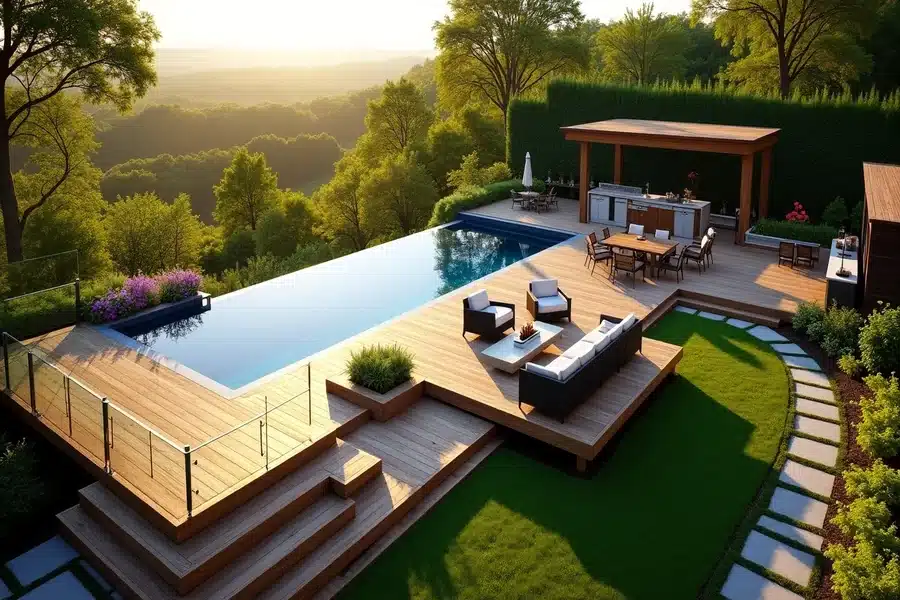
Most large backyard projects fail before a single stone gets laid. The problem isn’t the design – it’s everything that happens underneath it. Treat a yard remodel like a construction project, not a decoration exercise, and you’ll make a lot of right calls on where the budget needs to be.
Understand What You’re Working With Before You Touch Anything
The topography of your yard – the natural slope and contour of the land – is the single biggest factor that affects both the design and the long-term stability of any structure or area you build in your yard. A yard with poor drainage will destroy everything you put on top of it. So before you even think about where you’d like that garden bed, patio or lawn to go, put on your wellies during the next rainstorm and walk the space. Where does the water pool? There’s your best and most basic outline.
If your lot is at the mercy of a steep grade, or it’s composed of what some landscapers ominously refer to as “heavy clay,” you are not going to get to skip the expense of professional grading. You might want to think of it as “common sense in solid form.” That upfront professional grading, leveling and tamping down for an average-size backyard isn’t a small line item, we’re talking a few thousand dollars depending on the complexity of the job and what your soil is actually doing beneath the surface. If that sounds alarming, remember, it’s a whole lot cheaper than ripping out a sunken patio in year two.
Build a Material Hierarchy Before You Price Anything
Every square foot of your project isn’t deserving of the same material. Main patios and entry paths will be covered in durable hardscape (probably thick flagstone, concrete pavers, or natural stone). Secondary paths, decorative borders, and low-use areas can be composed of far more cost-competitive loose-fill materials without any functional loss.
Map your layout by traffic pattern, not aesthetics. Where will people actually walk? Where are they just going to look? That split drives your material choices, and in a large project, the cost difference between those two categories is significant.
Think In Cubic Yards, Not Bags
Many DIY projects face difficulty at this point. If you’re planning to cover a large surface with landscaping sand, gravel, or base material, it doesn’t make sense to buy individual bags from a store since this results in excessive costs and inconsistencies in color, texture, and particle size between batches for such a big project.
To avoid this, first, work out how many cubic yards of material you need. For square or rectangular areas, you’ll do this by multiplying length by width by depth (all given in feet), then dividing by 27. Sand is frequently used for filling the gaps between pavers or as a layer for them, and to create a foundational sub-base for a pool liner – applications like these will all benefit from a uniform layer over the entire work area. The best way to ensure this is to have bulk sand delivered to you.
Sand, of course, comes in a variety of types, each one suited to particular applications. For example, masonry sand is nice and fine – perfect for use with mortar or when installing an in-ground pool. Paver sand, on the other hand, is used for joint filling and interlocking pavers. Use the wrong kind in your project and you’ll just end up having to dig it back out again.
Prioritize Foundation Work Over Surface Work
A well-constructed hardscape feature actually has three or four layers of material rather than just one. While the top layer gets all the glory, the layers beneath are what will make it last five years or 30.
For most patio or walkway installs, that’s a compacted sub-grade, a layer of compacted gravel, a layer of sand to act as the “bedding” material, and then the pavers on top of that. The gravel is handling drainage. The sand layer is for easy, fine-tuning leveling and to give the pavers a little room to move and settle into.
Between your native soil and your new gravel base, put a piece of geotextile fabric. This helps keep the layers from slowly mixing over time which leads to settling and also helps block weed growth from beneath. In hard freeze climates, that’s doubly important – less movement in your base during freeze-thaw means less pavers being pushed out of alignment by the earth.
Compaction is not optional at any stage. A plate compactor on rented equipment does the job. Hand-tamping a sub-base for a 500-square-foot patio isn’t enough.
Balance Hardscape With Living Elements
Heavy hardscape features – large patios, retaining walls, extended walkways – change how water moves through a yard and reduce the natural soil coverage that absorbs it. Permeability drops. Heat retention increases.
Integrate native plants, mulch borders, and planted areas throughout the design to offset this. It’s not just about appearance. Native planting reduces the irrigation demand, helps manage runoff, and improves the ecological function of the whole yard. Xeriscaping principles work particularly well in dryer climates or areas where water use is a concern.
A yard that’s entirely hardscaped may look finished on day one and feel like a concrete lot by year three.
Large projects succeed or fail based on decisions made before anyone sees the finished result. Get the ground right, calculate your material volumes accurately, layer the foundation properly, and the surface work becomes straightforward.