
How to Reduce Sick Days Through Better Office Sanitation Practices
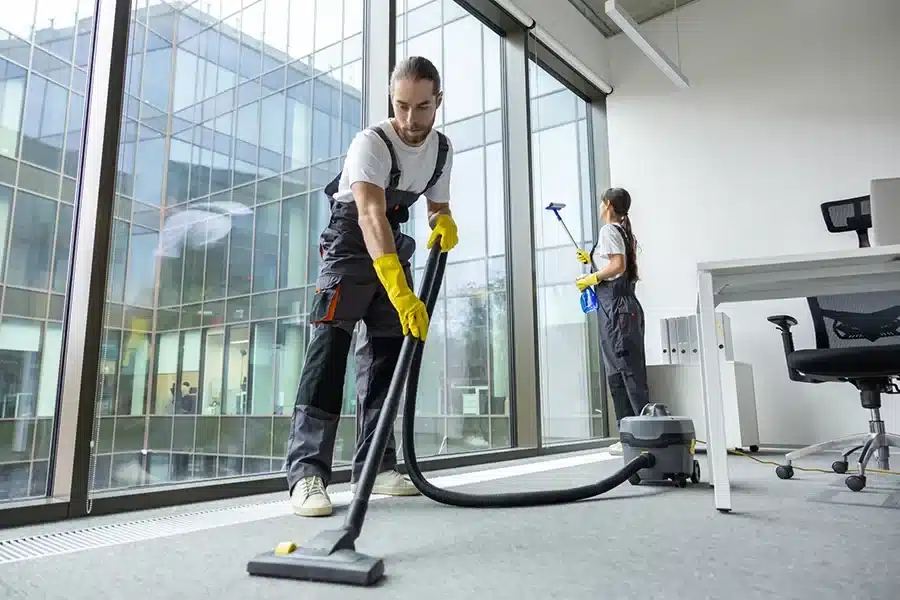
Most of us have gone to work with a cold, perhaps feeling more pressured by deadlines and urgent meetings than by the symptoms of illness. But a willingness to push through discomfort in an open-plan office contributes to the contagion of our colleagues. Researchers believe that the distribution of cold and flu viruses tracks the movement of office workers, transmitted by the countless objects we touch and the shared air we breathe.
Hot zones get touched hundreds of times a day
Most cleaning schedules treat the office as a single entity. It’s not. Your personal desk and an elevator button are not interchangeable surfaces. Elevator buttons, coffee pot handles, shared printer touchscreens, and conference room remotes are fomites – vehicles that facilitate the spread of infectious agents among hosts over and over again. They need to be disinfected on a different schedule than a floor or a window.
The same is true of breakrooms – it has been repeatedly shown that they typically have higher bacterial loads than restrooms. The fact that they’re often small rooms with poor ventilation, teaming with humidity, spills, and food remnants, and that improper, spoiled or even unlabelled food is often stored in them isn’t an acceptable excuse for allowing the coffee station or sink to become germ factories.
Replacing sponges weekly and wiping down the coffee station daily aren’t extreme measures. They’re standard practice for basic hygiene in a shared-environment room. Start by mapping out your office for frequency of touch, not floor space. That alone may shift your entire approach.
Cleaning, sanitizing, and disinfecting are not the same thing
The distinction is far more important than people realize. Cleaning lifts off dirt and debris. Sanitizing reduces the number of bacteria to safe levels as determined by public health codes. Disinfecting kills a specific percentage of germs – EPA regulations stipulate that a product must destroy 99.999% of bacteria within 30 seconds – on hard, nonporous surfaces.
But even that isn’t as simple as it sounds. To reach the bacteria, viruses, and fungi listed on its label, a disinfectant must be used precisely as you would in the lab: sprayed all over and allowed to sit and air dry. Those microscopic germs are incredibly hearty and resistant to destruction, but they can’t resist if they’ve been “wetted” (industry lingo for “sprayed”) and left in a room for 10 minutes with nothing to eat, which is the true way large outbreaks are averted.
This is another area where white vinegar and other DIY attempts don’t measure up, by the way. Most of those all-natural solutions have not been registered with the EPA because getting them on that list is long, costly, and difficult. But the companies who manufacture the most powerful cleaning chemicals have all had their products tested and flagged as disinfectants.
From visual clean to health-based clean
Some fewer companies can get away with a marginally cleaned facility. Others need a clean break room to keep up morale or a clean lobby to impress clients. But most want to limit the spread of germs, which means disinfecting office space to reduce pathogen load as much as possible.
That’s a fundamentally different goal. An office cleaner with a rag and a squirt bottle doesn’t have the training, the technology, or the oversight of a professional office cleaning service operating at the level of biohazard cleanup.
Indoor air quality is part of the equation
While surface sanitation is the most visible form of cleaning, indoor air quality has a direct impact on the respiratory health and number of sick days for employees. Dust, allergens, and particulate matter are constantly pulled into HVAC units and recirculated. They also settle on surfaces (often because they are blown there by the systems that heat and cool your building). A HEPA filter in your vacuum cleaner can capture the microscopic particles that a standard vacuum re-circulates into the air.
Changing filters when they’re due, cleaning out air vents and returns, and keeping humidity in a range that won’t encourage mold all contribute to a more healthful environment. This all needs to be part of any effective sanitation program. This isn’t extra work – it’s the part of the process that has an impact on every single person in the building for every single hour they’re there.
Clean desk policy does more than look professional
A policy insisting that employees clear loose items off their desks at the end of every day sounds a lot like management caring a bit too much what the cleaning staff think of their office space. Or, maybe even more cynically, a management’s fastidiousness being subbed in where actual leadership on substantive issues is lacking.
The bottom line
To minimize sick days, cleanliness should not be taken for granted as it is not the sole factor contributing to sanitation. The time, product, technique, and atmosphere should all be considered, and when managed properly, the decrease in absence due to illness will become evident from the budget report, not just from the office’s appearance.