
Buying a New Piano Today Means Choosing Between Centuries of Acoustic Tradition
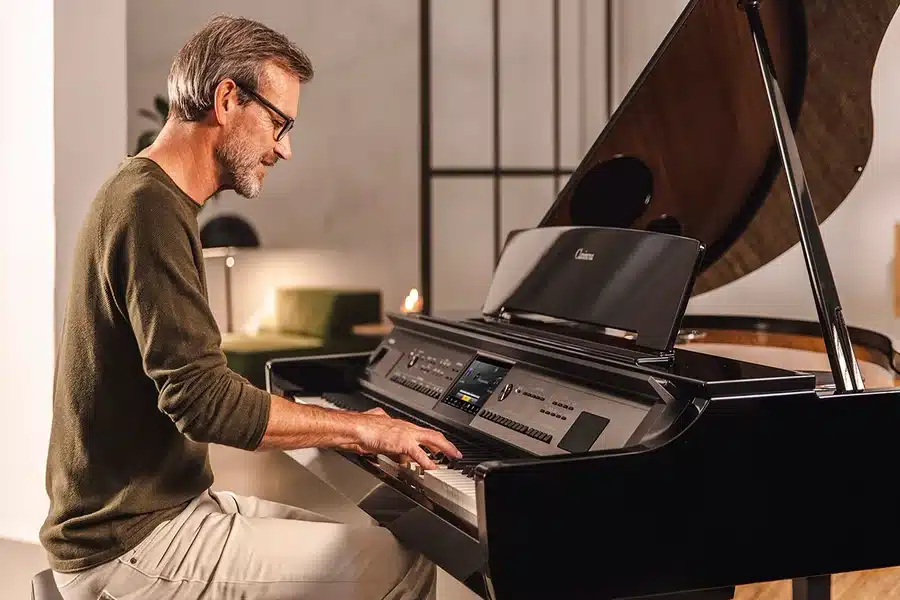
The piano market for new instruments has bifurcated in a way that would have been difficult to predict 20 years ago. On one side, the acoustic grand piano continues to represent one of the most sophisticated acoustic instruments ever designed — mechanically refined over two centuries to a level of subtlety that remains extraordinary. On the other, hybrid piano technology has matured to the point where several manufacturers are producing instruments that genuinely challenge the assumption that digital means inferior.
For a buyer considering a new piano purchase today, this means the decision involves a genuine trade-off rather than an obvious hierarchy. Acoustic grands offer properties that no electronic technology has fully replicated. Hybrid instruments offer capabilities — volume control, headphone practice, recording integration, maintenance simplicity — that acoustic instruments cannot match. Neither is right for every buyer, and the factors that determine the better choice are specific to how the instrument will be used, where it will live, and what the buyer values most about playing.
This guide works through both options in depth, covering the specific advantages of each, the scenarios where each performs best, and how to approach the decision as a new instrument purchase.
What the Acoustic Grand Does That Technology Hasn’t Fully Replicated
The acoustic grand piano’s defining characteristic is the physical relationship between the player and the sound-producing mechanism. When a key is pressed, the hammer physically strikes a string, setting it into vibration that resonates through the bridge, through the soundboard, and into the air of the room. The player feels the mechanics of this through the key — the weight, the escapement, the return — and that tactile feedback is inseparable from the sound in a way that creates a unified playing experience.
The strings of an acoustic piano also respond to sympathetic resonance — when the sustain pedal is held, all strings are free to vibrate in response to other strings being struck. A chord played with the sustain pedal creates a cloud of harmonic reinforcement from strings not directly struck. This physical phenomenon, which is part of what gives acoustic piano playing its characteristic richness, depends on real strings vibrating in real space and cannot be synthesized with complete fidelity.
A brand new grand piano from a top-tier manufacturer represents these acoustic properties at their highest development. The investment is significant, but the instrument it produces — tuned regularly, maintained well, and placed in an appropriate room — is one of the most sonically sophisticated instruments available in any category.
What Hybrid Pianos Offer That Acoustic Instruments Cannot
The practical advantages of hybrid piano technology begin with volume control. A hybrid instrument with headphone capability can be played at any hour without disturbing anyone in the household or adjacent apartments. For buyers in apartment buildings, shared housing situations, or homes with young children or irregular schedules, this is not a minor benefit — it can be the difference between playing regularly and playing rarely.
Recording integration in modern hybrids is a genuine capability, not a gimmick. High-quality hybrids record the MIDI data of a performance with precision that allows accurate playback, and many models include the ability to connect directly to digital audio workstations for professional recording applications. For composers, teachers who want to review student playing, or amateur musicians who want to document their progress, this capability adds real utility.
Maintenance is a practical consideration where hybrids hold a structural advantage. An acoustic piano requires professional tuning typically two to four times per year, regulation work on a longer interval, and periodic voicing to maintain consistent tonal character. A hybrid piano holds its pitch indefinitely, requires no tuning, and has minimal mechanical maintenance needs. Over a 10-year ownership period, the difference in maintenance cost is not trivial.
The Room and Noise Question
Where the piano will live shapes the decision more than any other single variable for many buyers. An apartment on the 12th floor of a building with shared walls and a noise complaint history is not the right environment for a concert grand. A dedicated music room in a private home with no close neighbors is not an environment where the headphone capability of a hybrid adds value.
Climate control is a related factor. Acoustic pianos are sensitive to humidity variation — the soundboard and pinblock are wood-based components that expand and contract with humidity changes, affecting tuning stability and, over time, structural integrity. In climates with extreme humidity swings, acoustic piano maintenance costs increase and the risk of long-term damage is higher. Hybrid instruments are unaffected by humidity in the same way, which is a meaningful practical advantage in certain environments.
The room acoustic question — how the instrument will sound in the intended space — affects acoustic grand selection specifically. A room that is too small for a large grand piano produces bass buildup and acoustic imbalance. A hybrid piano plays through its internal sound system and is not subject to room acoustic constraints in the same way, which gives it a practical advantage in rooms that weren’t designed with acoustic instrument placement in mind.
Who Buys Hybrids vs. Who Buys Grands
The buyer profiles for hybrid and acoustic instruments overlap but are distinct. Acoustic grand buyers tend to be serious students at the advanced level, adult learners who prioritize the authentic acoustic experience, established musicians, and buyers for whom the piano is as much a furniture and cultural statement as a musical instrument. The acoustic grand in a well-appointed home carries aesthetic and cultural weight that a hybrid does not replicate.
Hybrid buyers tend to prioritize practical capabilities: regular playing without noise constraints, the ability to record or connect to digital workflows, lower maintenance requirements, and the ability to update or recalibrate the instrument as the technology evolves. Teachers who give lessons in apartment settings, composers who work at night, home studio musicians who want piano sounds without tuning overhead — these are the profiles that hybrids serve well.
There is also a meaningful segment of buyers who want the physical keyboard of a quality piano — the weight, the feel, the layout — for practicing finger technique and repertoire, but who primarily play in digital or amplified contexts. For these buyers, a high-quality hybrid provides the practice experience that matters (authentic key action) without requiring the acoustic infrastructure (room acoustics, isolation, regular tuning) that a full acoustic instrument demands.
What to Play Before You Decide
The hybrid piano technology spectrum ranges from instruments whose key action is barely distinguishable from an average digital piano through instruments with purpose-designed grand piano actions at the highest end. The difference between the low and high end of this range is audible and tactile to any pianist who plays both. Evaluating hybrid instruments at multiple price points — rather than forming an opinion of the category based on one experience — is essential to an informed comparison.
Similarly, the acoustic grand category spans from entry-level baby grands that represent their manufacturers’ most affordable offering through professional instruments that represent decades of refinement. Playing a $7,000 baby grand and an $18,000 professional parlor grand back to back reveals differences that matter for an experienced player.
A dealer with a comprehensive range of new pianos for sale — covering both acoustic and hybrid options across multiple price points — is the best environment for making this comparison. The ability to move between a hybrid and an acoustic instrument in a single visit, on instruments that are properly regulated and in good playing condition, produces experiential data that no specification comparison can replicate.
At the high end of the hybrid category — instruments in the $10,000 to $20,000 range — the playing experience approaches acoustic quality in ways that instruments a decade ago did not. Grand piano actions with physical escapement, multiple speaker systems calibrated for spatial realism, and recording capabilities at professional quality are now available in this category.
These instruments represent a genuine alternative to acoustic grands in the $15,000 to $25,000 range for buyers whose primary constraint is noise or maintenance rather than acoustic purity. Comparing a high-end hybrid directly to an acoustic grand in the same price range — on the same day, at the same dealer — is the most informative evaluation a buyer in this range can do.
The depreciation curves for hybrid and acoustic instruments differ as well. High-quality acoustic grands from established manufacturers retain value well over time, particularly instruments that are regularly maintained. Hybrid instruments, as technology products, follow a different curve — their value reflects the technology generation they represent, which means older hybrid models may depreciate more than acoustic instruments of equivalent original cost. Buyers with long-time horizons who consider resale value as part of the purchase decision should factor this in.