
AI in the Workplace: Benefits, Risks, and Best Practices
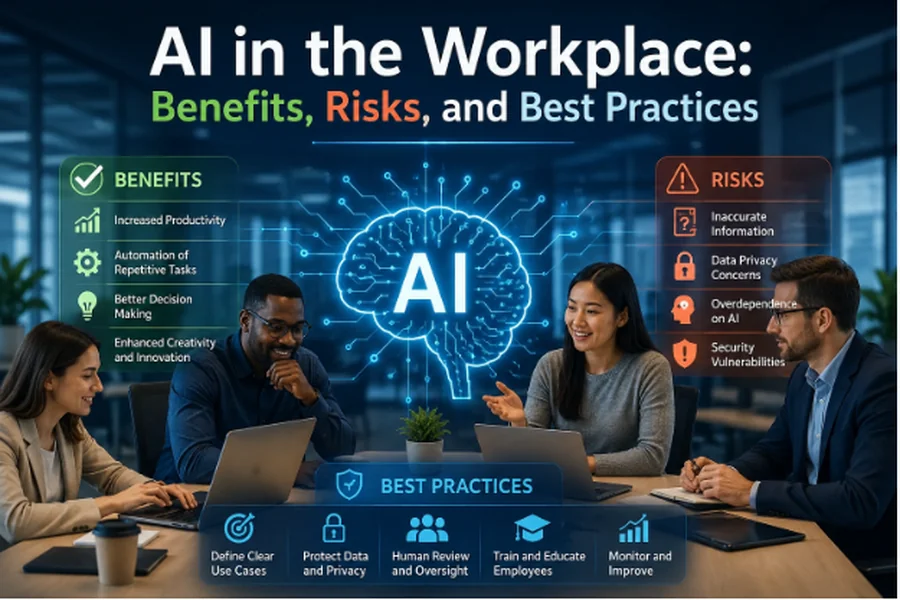
Artificial intelligence has quickly become a practical part of the modern workplace. Businesses of all sizes are using AI-powered tools to write content, analyze information, automate repetitive tasks, support customers, review documents, assist with coding, and improve everyday decision-making. Instead of being limited to technology companies, AI is now relevant to marketing teams, finance departments, developers, customer service professionals, managers, and many other roles.
However, introducing AI into the workplace is not simply about finding a tool and asking employees to use it. Businesses also need to understand where AI provides genuine value, where it can make mistakes, and how sensitive company information should be handled. Resources such as https://evostai.com/ focus on practical workplace AI use, including checking AI-generated answers, protecting company data, evaluating tools, and determining whether AI actually saves time.
How AI Is Changing the Modern Workplace
AI is changing work primarily by helping people complete certain tasks faster. Employees can use AI to summarize lengthy information, create first drafts, organize ideas, analyze text, generate reports, answer routine questions, and automate repetitive processes. This can reduce the amount of time spent on low-value administrative work and allow employees to concentrate on tasks that require experience, judgment, creativity, and human interaction.
The biggest change is not necessarily the replacement of entire jobs. In many workplaces, AI functions more like an assistant. It can prepare an initial version of something, identify patterns, suggest possible solutions, or organize information. A person can then review the result and decide what should actually be used.
Benefits of AI in the Workplace
One of the most important benefits of AI is increased productivity. Many employees spend a significant portion of their day performing repetitive tasks. AI can help reduce this workload by handling first drafts, routine analysis, summaries, data organization, and other predictable activities. When implemented properly, this can shorten the time required to complete everyday work.
AI can also improve access to information. Instead of manually reading multiple documents or searching through large amounts of text, employees can use AI to identify relevant information and create summaries. This is particularly useful when a worker needs a quick overview before conducting a more detailed review.
Another advantage is support for creativity and problem-solving. AI can generate ideas, suggest alternative approaches, rewrite text, explain complicated subjects, and help employees overcome the difficulty of starting a new task. It does not need to make the final decision to be useful. Sometimes simply providing several possible directions can make a person’s work easier.
Businesses may also use AI to improve consistency. For example, teams can develop standardized prompts, workflows, and review procedures for recurring tasks. This can help employees follow a similar process while still allowing humans to approve the final result.
The Risks of Using AI at Work
Despite its benefits, AI has significant limitations. One of the most important is accuracy. AI-generated information can sound convincing even when some details are incorrect. This creates a particular risk when employees assume that a professional-looking response must be reliable.
Incorrect information can have serious consequences in areas involving financial decisions, legal matters, technical systems, contracts, customer communications, or important business strategies. For this reason, employees should treat AI-generated content as something that may require verification rather than automatically considering it a trusted source.
Privacy is another major concern. Employees may unintentionally paste confidential business information, customer data, internal documents, passwords, financial details, or other sensitive information into an AI system. Organizations therefore need clear rules explaining which information employees are permitted to provide to AI tools.
Businesses should also consider overdependence. If employees begin relying on AI for every decision, they may gradually reduce their own critical thinking and verification. AI should support professional judgment rather than eliminate it.
Human Review Remains Essential
Human oversight is one of the most important principles for responsible workplace AI use. The amount of review required should depend on the importance of the task. A brainstorming exercise may require minimal checking, while financial information, technical instructions, published content, or customer-facing material deserves much closer examination.
Employees should verify important facts, numbers, names, dates, references, and conclusions before relying on AI-generated information. When possible, important claims should be compared with original or authoritative sources.
The goal should not be to distrust every AI response. Instead, businesses should develop a verification process appropriate to the consequences of an error.
Protecting Company and Customer Data
Organizations should establish clear data protection rules before allowing widespread AI use. Employees need to understand what information can be entered into approved tools and what information must remain private.
Confidential client information, authentication credentials, private contracts, unreleased financial information, proprietary business data, and personally identifiable information should receive particular attention. Companies should review the privacy and data-processing terms of AI services rather than assuming every tool handles information in the same way.
An effective internal AI policy should be understandable to ordinary employees. Complicated policies are less useful if workers cannot quickly determine whether a particular action is permitted.
Best Practices for Using AI at Work
A good workplace AI strategy starts with specific tasks rather than adopting AI simply because it is popular. Businesses should identify repetitive or time-consuming processes and determine whether AI can meaningfully improve them.
Employees should provide sufficient context when using AI. Clear instructions about the desired objective, audience, format, limitations, and examples can significantly improve the usefulness of the output. At the same time, employees should avoid including sensitive information unless the organization has explicitly approved its use with that particular system.
Companies should also measure results. Saving five minutes during content generation provides little value if another employee must spend twenty minutes correcting the output. The entire workflow should therefore be considered when determining whether an AI tool actually improves productivity.
Training is equally important. Employees should understand both the capabilities and limitations of the tools they use. Knowing how to write effective instructions is useful, but knowing when not to trust an answer is even more important.
Creating a Practical AI Policy
As AI adoption increases, organizations should consider creating a straightforward internal policy. The policy can explain which AI tools are approved, what types of company information cannot be shared, when human verification is mandatory, and who is responsible for AI-assisted work.
The organization should also establish a process employees can follow when they are uncertain. Workers should know whom to contact before using AI for sensitive or unusual tasks.
A practical policy does not need to prevent experimentation. Its purpose is to create reasonable boundaries so employees can benefit from AI without exposing the company to unnecessary privacy, accuracy, security, or compliance risks.
Finding the Right Balance Between AI and People
The most effective workplace AI strategies recognize the strengths of both technology and people. AI can process information rapidly, automate predictable work, create drafts, and generate possible solutions. Humans provide contextual understanding, responsibility, ethical judgment, professional experience, and an understanding of consequences.
Businesses should therefore focus on human-AI collaboration rather than complete automation. AI can perform the first stage of a task while an employee reviews and improves the result. In other situations, a person may make the decision while AI provides supporting information.
Conclusion
AI offers businesses meaningful opportunities to increase productivity, reduce repetitive work, improve access to information, and support employees across many different tasks. At the same time, inaccurate outputs, privacy concerns, security issues, and excessive dependence on automated systems can create new risks.
Successful adoption requires more than access to powerful technology. Organizations need clear policies, employee training, appropriate data protection, human oversight, and realistic measurement of whether AI actually improves a workflow. By combining AI’s speed with human judgment and accountability, businesses can gain the benefits of workplace AI while managing its limitations responsibly.