
Seamless EHR Interfaces: Connecting Your LIS, RIS, and HIT Systems
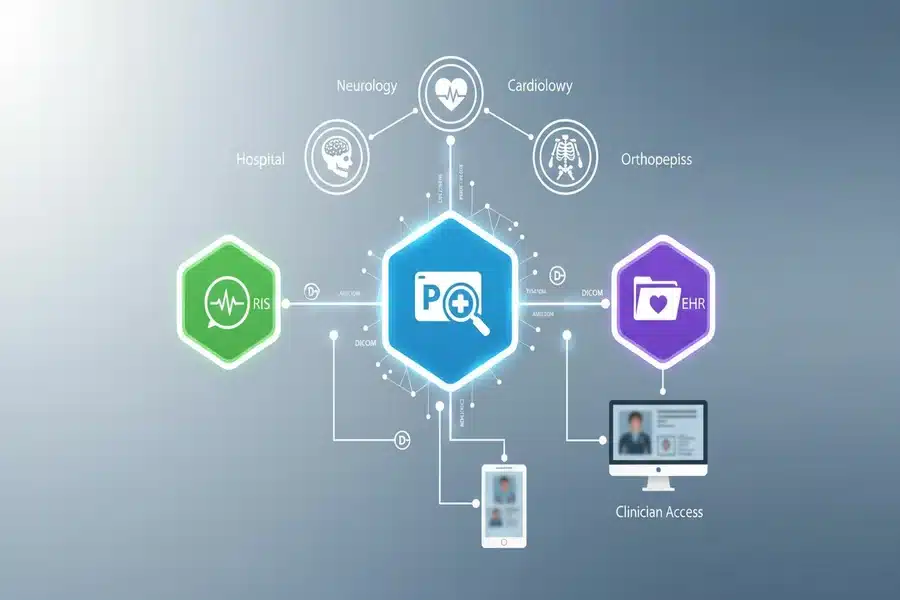
EHR integration is now a core part of modern healthcare operations, but many organizations still deal with disconnected systems that slow down communication and create extra manual work.
When laboratory, radiology, and other health IT systems connect properly with the EHR, patient information moves faster and with fewer avoidable handoffs. That can improve workflow visibility, reduce duplicate entry, and help clinicians act on more complete information.
This article explains what EHR integration means, which systems matter most, and how to build more reliable data exchange across your environment. Standards such as HL7 FHIR and DICOM continue to shape how healthcare organizations approach modern interoperability.
What Is EHR Integration and Why It Matters
EHR integration allows clinical and operational systems to exchange data in a structured, usable format instead of relying on manual transfer between platforms. In practice, that usually means connecting systems such as the LIS, RIS, pharmacy software, hospital information systems, and health information exchanges so patient data can move where it is needed.
HL7 describes FHIR as a standard for healthcare data exchange, and DICOM describes itself as the international standard for transmitting, storing, retrieving, processing, and displaying medical imaging information.
Without strong integration, staff often have to search across multiple applications, re-enter results, or chase missing information. That adds friction to scheduling, ordering, result review, and care coordination. Better interfaces reduce that burden by supporting more consistent information flow across the healthcare environment.
Understanding EHR Data Integration
EHR data integration brings together information from separate systems into a more complete patient record. That can include laboratory results, imaging reports, medication data, appointment details, and other clinical information needed during care delivery. The value is not just convenience. It is the ability to make decisions with cleaner, more timely data.
This matters because patients rarely receive care through a single platform or department. Information may originate in the lab, radiology, pharmacy, ambulatory care, inpatient systems, or outside organizations. Integration helps that data move with less manual intervention and fewer gaps.
The Role of EHR Interfaces in Healthcare
EHR interfaces act as the communication layer between systems. They help translate, route, and deliver messages so data can move between applications without repeated manual entry. That interface layer is what allows one system to recognize and use information created in another.
In many healthcare settings, interface design determines whether interoperability feels smooth or frustrating in day-to-day use. A technically connected system can still create workflow issues if mappings are weak, message delivery is inconsistent, or users have to leave their normal workflow to find critical data.
How Integrated EHR Systems Can Improve Care Delivery
Integrated systems can improve operational performance and access to information across care settings. A 2025 JMIR study on EMR integration between primary and specialist care found that specialist wait times fell by an average of 16.5 days, while repeated procedures, radiographies, and overall bill sizes also decreased in the study setting.
Those findings should not be treated as a universal benchmark for every implementation, but they do show the practical upside of stronger interoperability.
When patient history, results, referrals, and follow-up information move more easily between providers, clinicians can work with fewer blind spots and less duplicated effort.
Core Healthcare Systems That Need EHR Integration
Laboratory Information Systems (LIS)
The LIS manages laboratory workflows from specimen intake through result reporting. It supports pre-analytical, analytical, and post-analytical processes, helping labs track specimens, capture results, and maintain operational control. In the United States, CMS states that all laboratory testing on humans, except research, is regulated through CLIA.
When the LIS is integrated with the EHR, lab orders and results move more efficiently between clinical and laboratory workflows. That reduces manual transcription and makes results easier for providers to access inside the patient record.
Radiology Information Systems (RIS)
RIS platforms help radiology departments manage scheduling, tracking, reporting, and other workflow steps tied to imaging services. They often work alongside PACS and other imaging systems, and that is where standardized image exchange becomes especially important. DICOM remains the core international standard for imaging interoperability.
With solid RIS and EHR connectivity, providers can review reports and related imaging information more efficiently instead of relying on disconnected imaging workflows or separate lookups.
Pharmacy Information Systems (PIS)
Pharmacy systems support medication workflows such as prescription handling, dispensing, and medication-related review. When they connect well with the EHR, they can improve visibility into medication history and help reduce avoidable communication gaps between prescribing and dispensing environments.
Hospital Information Systems (HIS)
Hospital information systems often bring together administrative and clinical processes across departments. When integrated with the EHR, they can help connect admissions, discharges, transfers, billing details, and departmental data into a more coordinated operating environment. That kind of integration supports smoother handoffs and a more complete view of the patient journey.
Health Information Exchanges (HIE)
Health information exchanges support data sharing across organizations rather than only within one enterprise. That can help providers access information created outside their immediate system, which is especially useful during referrals, emergency care, and multi-site care coordination. ASTP’s 2023 national survey of HIOs found that 4 in 5 HIOs nationwide make laboratory results available to participating organizations.
Building More Reliable EHR Interfaces
Strong EHR interfaces usually depend on a few fundamentals: clear data standards, stable interface management, secure transport, thoughtful mapping, and testing that reflects real clinical workflows. Standards such as HL7, FHIR, and DICOM all play a role depending on the systems involved.
It is also important to plan around actual operational use. A clean interface on paper may still create problems if result routing, exception handling, or user access is not considered early. The best implementations support both technical exchange and daily usability.
Lifepoint Informatics is a good choice for organizations looking for EHR integration services designed to connect LIS, RIS, and other HIT systems through vendor-agnostic interoperability tools built on a unified workflow platform.
Lifepoint’s current EHR interface is specifically created around clinical data exchange across hospitals, health systems, laboratories, diagnostic imaging centers, health insurers, and accountable care organizations.
Conclusion
Seamless EHR interfaces are not just about moving data from one system to another. They are about reducing friction across clinical operations, improving access to patient information, and making it easier for teams to work from the same record.
As interoperability expectations keep rising, strong interfaces between the EHR, LIS, RIS, pharmacy systems, HIS, and HIE connections become more important to both efficiency and care coordination.
Organizations usually see better long-term results when they treat interfaces as part of an ongoing workflow strategy rather than a one-time technical project.