
How Robotic Laser Welding Is Redefining Productivity and Precision
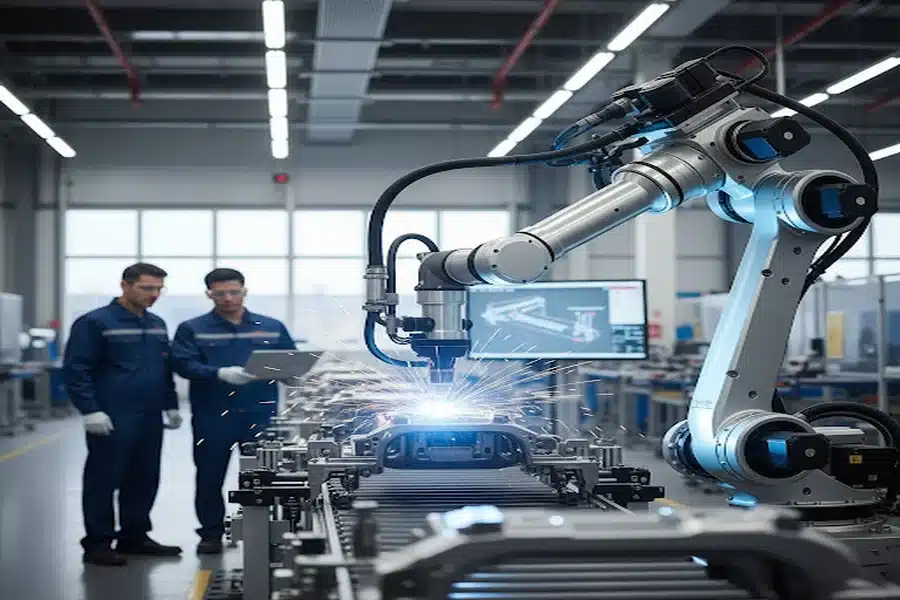
If you’re trying to meet rising production targets without sacrificing quality, you’re not alone. Many manufacturers today face a tough balancing act: improve precision, increase throughput, and reduce dependency on manual labor—all while keeping costs under control. That’s exactly why robotic laser welding has become a go-to solution in industries like automotive, aerospace, metal fabrication, and electronics.
By combining the speed and accuracy of laser welding with the controlled motion of a robotic arm, manufacturers get a fully automated process capable of producing consistent, high-quality welds at scale. As demand for tighter tolerances and greater repeatability grows, robotic laser welding is delivering the reliability modern production lines need.
Common pain points you may face today include:
- High defect rates caused by inconsistent manual welding.
- Labor shortages or limited availability of skilled welders.
- Slow cycle times that restrict production capacity.
What Robotic Laser Welding Is
Definition and Core Components
At its heart, robotic laser welding integrates a laser welding source with a programmable robotic arm—often a 6-axis system—capable of moving with exceptional precision and repeatability. A typical setup includes:
- Laser source: fiber, diode, or other industrial laser types.
- Beam delivery optics: lenses, nozzles, and fiber delivery systems.
- Robotic manipulator: a multi-axis arm for precise motion paths.
- Control software: manages speed, laser parameters, and movement.
- Optional sensors/vision: for seam tracking and adaptive corrections.
Together, these elements create a highly efficient, automated welding cell that can handle complex or repetitive welds with minimal variability.
How It Differs From Traditional Welding
Compared with manual MIG/TIG welding—or even older robotic arc systems—robotic laser welding delivers:
- Narrower heat-affected zones (HAZ)
- Higher travel speeds and cycle-time reduction
- Far greater repeatability across long production runs
- Cleaner welds with less distortion and less rework
Robotics add speed, endurance, and precision—while laser welding adds accuracy, control, and superior weld quality.
Major Productivity Benefits
1. Speed and Throughput Gains
Laser welding achieves deep penetration and high travel speeds, often several times faster than conventional welding. Robotic systems amplify this by operating:
- Continuously with no fatigue
- On multi-shift or 24/7 cycles
- With predictable takt times and minimal idle time
For manufacturers dealing with high-volume production, this combination dramatically increases daily output.
2. Precision, Quality, and Repeatability
Because both the beam and the robot path are controlled digitally, robotic laser welding ensures:
- Uniform, precise welds across thousands of parts
- Significantly fewer defects, burn-throughs, or distortions
- Minimal spatter and cleaner seams—reducing post-processing
For industries requiring tight tolerances, this level of repeatability is a major advantage.
3. Flexibility and Automation Integration
Modern robotic laser welding cells are designed for flexible use:
- Rapid job changes with stored digital programs
- Fast adaptation to different part geometries
- Compatibility with sensors, seam tracking, and offline programming
- Support for high-mix/low-volume manufacturing
This flexibility allows you to handle complex projects without major downtime.
4. Cost and Labor Savings
By automating repetitive or technically demanding welds, you:
- Reduce reliance on hard-to-find skilled welders
- Minimize human error and material waste
- Lower cost per part due to efficiency gains
- Spend less on consumables and post-weld finishing
The long-term savings often outweigh the initial system investment.
Precision Benefits and Material Capabilities
Narrow Heat-Affected Zone & Low Distortion
Laser welding’s concentrated energy input creates a narrow HAZ and reduces:
- Warping and deformation
- Internal stresses
- Heat-related defects
This is crucial for thin metals, delicate assemblies, and high-precision components.
Handling Complex Geometries, Thin Materials & Dissimilar Metals
Robotic laser welding excels where traditional methods often struggle:
- Thin sheets that require tight thermal control
- Aluminum, copper and conductive alloys
- Dissimilar metals that need precise parameter balancing
- Curved or multi-angle joints requiring dynamic robot paths
You gain the ability to weld challenging materials without over-heating or compromising integrity.
Repeatable High-Quality Welds in Demanding Industries
High-value sectors like aerospace, automotive, medical, and electronics rely on robotic laser welding for applications where every micrometer matters.
Key Applications Across Industries
Automotive & E-Mobility
Used for battery enclosures, body-in-white welding, thin lightweight panels, and structural components.
Aerospace & Defense
Ideal for exotic alloys, high-integrity structural frames, and mission-critical components requiring flawless joints.
Electronics, Medical & Precision Manufacturing
Used in sensor housings, micro-welds, conductive joints, and assemblies requiring minimal heat input.
Heavy Fabrication & Metal Structures
Robotic laser welding helps scale production while maintaining excellent precision on large or thick components.
Implementation Considerations and Challenges
Capital Investment & ROI
Yes, robotic laser welding systems require more upfront investment than manual stations. However, ROI often becomes clear through:
- Higher throughput
- Lower scrap rates
- Fewer rework hours
- Reduced labor dependency
- Lower operational cost per part
For medium to high-volume manufacturers, the long-term payoff can be substantial.
Process Design, Programming, and Setup
A successful deployment requires planning around:
- Robot path programming
- Laser parameters
- Fixturing and part alignment
- Joint preparation and fit-up
Offline programming software helps reduce setup time and avoid line downtime.
Material & Joint Fit-Up Constraints
Reflective metals, large gaps, or poor fit-up can create welding challenges. Matching laser type, optics, speed, and focus to the material is essential for quality.
Training, Safety, and Maintenance
Operators should be trained in:
- Robot control and basic programming
- Laser safety protocols
- Optics maintenance and beam alignment
- Diagnosing weld defects
A well-trained team ensures consistent system performance.
Integration Into Production Lines
Consider:
- Part loading/unloading
- Cycle time alignment
- Cell layout and robot reach
- Quality inspection and data capture
- Automation triggers and sensors
A fully integrated cell is more productive, safer, and easier to scale.
Why Denaliweld’s Robotic Laser Welding Solutions Stand Out
If you’re exploring robotic laser welding, Denaliweld offers a solution designed for precision, efficiency, and smart automation. Their robotic laser welding systems—including the Cobot Series—combine high-quality laser performance with smooth robotic motion and digital job setup. This gives you a future-proof foundation optimized for modern manufacturing environments where speed, consistency, and adaptability are essential.
Conclusion
Robotic laser welding is reshaping how manufacturers approach productivity, precision, and automation. By merging robotic consistency with laser accuracy, you get cleaner welds, faster throughput, fewer defects, and lower long-term costs. While the transition requires investment and planning, the benefits are significant—especially for high-volume or precision-driven industries.
With the right equipment and partner, you’re positioned to meet the demands of next-generation production. Manufacturers choosing advanced robotic laser welding solutions from trusted providers like Denaliweld can build a competitive edge that lasts well into the future.