
Understanding the Signature Stamps on Polish Pottery

If you’ve ever picked up a piece of Polish pottery, you probably noticed the unique markings on its bottom. These markings aren’t random; they are signature stamps that show where the piece comes from, the quality, and sometimes even the name or initials of the artist who decorated it.
Learning what these stamps mean helps you better recognize and enjoy the craftsmanship behind each piece.
Made in the busy town of Bolesławiec, Poland, this stoneware represents generations of skill and tradition. These markings matter, especially if you appreciate traditional Polish pottery, because they reveal whether a piece is from a factory line or an individual artist.
Once you know how to read them, you move from simply liking the pottery to truly understanding what makes each piece special.
Why Do Polish Pottery Pieces Have Signature Stamps?
Signature stamps on Polish pottery have several main jobs. First, they confirm that the item is real and made in a known Polish pottery factory. With many companies producing these items, these stamps show which factory made each piece.
Some factories focus on top quality, while others are more about looks. For example, Ceramika Artystyczna (CA) stamps its pottery to prove its high-quality standards; their dishes can still look new after many years of use.
Stamps also give useful details. They might show the pattern number, factory name, and sometimes the initials or name of the artist who decorated the piece. Stamps tell us that each item was made with great care and skill, often by a small team. In short, they connect us to the makers and the long history of Polish pottery.
Where Can You Find Signature Stamps on Polish Pottery?
You will usually find signature stamps on the bottom of each piece. Flip over a cup, plate, or bowl, and you’ll see the markings there.
While the location is almost always the same, the look and details of the stamp change depending on the factory and on whether the item is a regular piece or a special UNIKAT type. Always check the base-it holds the item’s story.
Types of Signature Stamps and Markings
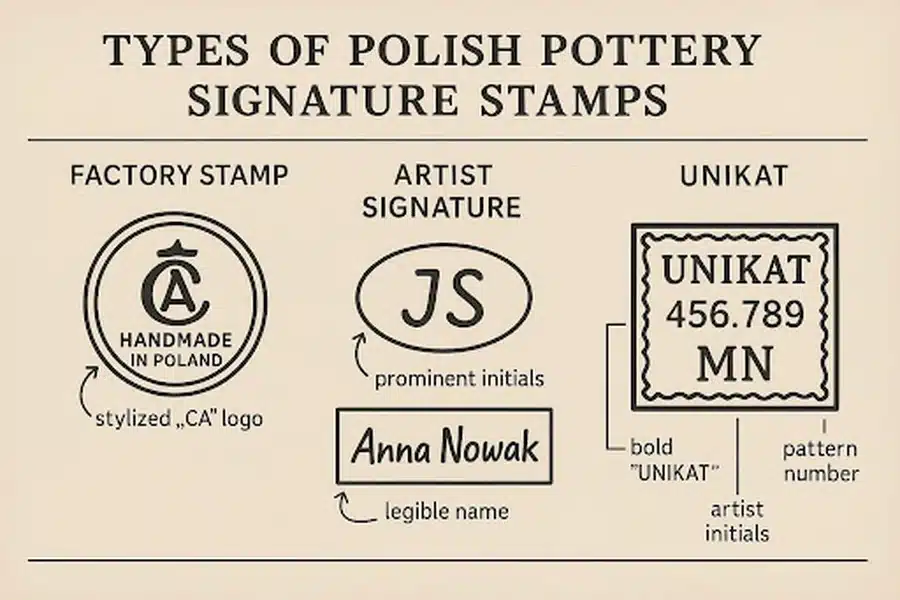
Polish pottery stamps come in many forms, just like the patterns painted on the pieces. There isn’t a single, universal mark for all items. Instead, these stamps and signatures each carry certain details about how and where each item was made. Collectors can learn a lot about an item’s background just by studying these marks.
Factory Stamps
All real Polish pottery carries a stamp from its factory-this is the main way to tell where the piece was made. These stamps often show the factory name or logo, such as “Ceramika Artystyczna (CA),” “Manufaktura,” “Vena,” “Galia,” “Kalich,” or “Andy.” A CA stamp, for example, means the piece is of the highest quality, where cracks or glaze faults are very rare on their top items.
The factory stamp often includes the words “Handmade in Poland,” which proves the item was made using traditional methods. Clear, legible factory stamps are the most basic way to check if an item is real.
Artist Signatures
Some higher-level or unusual Polish pottery pieces have an artist’s signature or initials. This puts a personal touch on the pottery, linking it directly to the person who painted the pattern. For most pieces, the artist is not the one who created the pattern design, but their initials may appear at the bottom, showing who painted the pottery.
Having an artist’s signature doesn’t always mean a piece is worth more, but it does make it more meaningful for collectors. UNIKAT pieces will have the designer’s name or initials stamped on the back, which is a special way to honor creativity and skill.
UNIKAT Stamps and Classifications
“UNIKAT” (which means “unique” in Polish, borrowed from German) marks a group of Polish pottery known for complex, detailed patterns. If you see the word “UNIKAT” on a stamp, it means the design is more special and harder to make compared to standard pieces. These items often also list the pattern number and the name or initials of the artist who designed it.
UNIKAT items fall into several levels, such as U2, U3, U4, U5, U6, U7, and U8, plus Limited Edition (which stopped being made in 2021). The higher the number, the more skill and time go into painting it. Limited Edition items are now rare and very collectible.
Limited Edition and Special Series Stamps
Some stamps show that a piece was part of a Limited Edition or special series. Ceramika Artystyczna, for example, stopped producing new Limited Edition patterns in 2021, which makes older pieces even more valuable for collectors. Painting these can take several days, showing careful effort and top skill. Owning one means you have something rare and highly prized.
What Makes UNIKAT Polish Pottery and Its Stamps Different?
UNIKAT Polish pottery stands for the highest skill and creativity in Bolesławiec stoneware. The word “UNIKAT” (‘unique’) tells you these pieces are beyond regular patterns. While mass designs are made with more standard steps, UNIKAT pottery is famous for tricky designs and careful painting.
The stamp on UNIKAT items clearly says “UNIKAT,” along with the pattern number and name or initials of the pattern designer. This is a major difference; regular pieces usually have just a factory stamp and pattern number, but UNIKAT pieces credit their artists right on the bottom.
What “UNIKAT” Means in Polish Pottery
Within Polish pottery, “UNIKAT” shows that a piece is carefully made and has a design created by a master artist. Every UNIKAT piece is hand-painted, never made on a production line. The designs often use detailed brushes instead of just the basic sponge technique used for regular pottery. The time, effort, and artist’s personal touch make these pieces more valuable and sought-after.
Usually, the stamp credits the artist who created the pattern, but sometimes a different person does the painting. Still, the main idea belongs to the pattern designer, and their name on the stamp proves that.
Levels of UNIKAT Quality (U2-U8)
Ceramika Artystyczna sorts UNIKAT patterns into levels, from U2 to U8, with older Limited Editions no longer produced as of 2021. These levels show how much time, detail, and skill went into each:
- U2: The basic UNIKAT level, unique but often similar in complexity and price to standard pieces.
- U3 and U4: These are “regular” UNIKAT levels. The patterns are more detailed, and while the gap between U3 and U4 is there, it might be hard for newcomers to notice.
- U5-U8: These levels show much more complex designs, require more time, and cost more. They’re considered true works of art.
- Limited Edition: No longer made since mid-2021. They are the rarest, most detailed, and were sometimes painted over several days. Collectors value them very highly.
With each higher level, the piece becomes more detailed and impressive.
Why UNIKAT Pottery Costs More
The main reasons UNIKAT pottery is more expensive are the skill involved and the time it takes to paint each piece. These items are often painted by just one person, from start to finish, rather than as part of a team process. Each piece truly is one-of-a-kind.
Also, because fewer are made, they’re rare. This is especially true for the high-level U series and older Limited Edition items, which are now considered collector’s pieces. Many people keep UNIKAT pottery for special occasions or display, making them valuable family heirlooms.
Traditional vs. UNIKAT Stamps: What’s the Difference?
Looking closely at the signature stamps on Polish pottery shows clear separation between traditional and UNIKAT items. While both are handmade and attractive, their stamps show differences in production and the way artists are recognized.
Production and Marking Styles
Traditional Polish pottery often uses simple patterns with the sponge stamping method. Artists cut small sponges to stamp patterns onto dishes, making it possible to produce more pieces quickly. That also means these items are usually more common and cost less. On these, you’ll find the factory stamp and a pattern number but rarely a specific artist’s signature, since many worked together on the same design.
UNIKAT pottery, by contrast, uses more detailed brushwork, needs more time from a skilled artist, and offers more complex patterns and a wider color range. Making one UNIKAT item can take much longer because a master artist oversees the whole process.
The stamp will always include “UNIKAT,” the factory mark, the pattern number, and the name or initials of the designer, proving the artist’s special role in creating that piece.
Pattern and Artist Credit
For regular patterns, the design is shared among many artists, so the focus is more on the factory than any single person. Each is hand-painted, but based on a set design. The main idea is to show off the craftsmanship of the whole workshop.
For UNIKAT patterns, a single lead artist’s idea is central. Only top-tier artists are trusted to make or repeat UNIKAT designs. That’s why their name or initials are stamped on the piece, recognizing them and setting these items apart as individual works of art.
How to Read Polish Pottery Markings
Understanding the marks on Polish pottery helps you figure out where an item comes from and if it’s real. These marks help buyers and collectors check the pottery’s background and sort items by factory, artist, and quality.
How to Spot Real Polish Pottery
The first thing to look for is “Handmade in Poland.” This proves the piece is authentic. Next, check the factory stamp; top brands like Ceramika Artystyczna (CA) have clear, steady marks. If the stamp is missing or looks smeared, be careful-it could be a fake.
You might see a ‘gatunek’ label (shortened to “Gat.”) on a sticker, which rates the quality from 1 (best) to 5 (lowest). CA’s best items (Quality 1) resist cracks and glaze flaws. A blue sticker usually means it was bought directly at the factory store in Poland, and a white one means it was specially ordered. Always look for these when buying.
Hand-Stamped, Hand-Signed, and Printed Stamps
How the mark was added tells you more. Most factory and pattern numbers are hand-stamped, giving each mark small differences. Higher-level UNIKAT pieces may have hand-signed names, while others might have a stamped signature, sometimes used by factories like CA. Printed marks are sometimes found on mass-made pottery, which is a warning sign of a fake.
Color and Pattern Codes
While many think of Polish pottery as blue and cream, the stamp itself usually doesn’t mention the color. Instead, it focuses on the pattern number. For UNIKAT, the pattern number is on the bottom. For other designs, you may need to check with the seller or a pattern guide to find the number, as it may not be on every piece.
How to Spot Fake Stamps
Because real Polish pottery is popular, copies or fakes sometimes appear. Looking closely at the signature stamps helps you avoid wasting money on imitation pieces. Check the stamp details carefully-it’s the best way to avoid being tricked.
Common Fake Stamp Warning Signs
If an item doesn’t have “Handmade in Poland,” that’s a bad sign. All genuine items should have it. Stamps that are smudged, hard to read, or stamped too perfectly (without any small differences) may be mass-made and not real. Spelling mistakes or odd-looking factory names also show a piece may be a fake. If “UNIKAT” appears without a pattern number or artist’s name or initials, you should also be wary.
How to Confirm a Piece is Authentic
Buy only from shops that specialize in Polish pottery and are known for being honest. These sellers usually work directly with factories. They should be able to tell you the factory, pattern, and quality score for every piece.
Always look for a ‘gatunek’ (quality) sticker, most often blue or white for Quality 1. Other colors show lower grades. Missing stickers or stickers that look disturbed can hint at problems. Genuine pieces are made to last. If a dish feels weak or looks worn, it could be a fake.
How to Care for Polish Pottery with Stamps
Polish pottery is known for its beauty and ability to handle daily use. It can go in the oven, microwave, dishwasher, and freezer. Still, taking good care of the printed stamps ensures they stay clear and easy to read for years to come.
Will the Signature Stamps Fade?
While the pottery itself is tough, the underside stamps can fade over time, especially if cleaned with harsh chemicals or rough sponges. The stamps are put on before glazing and firing, so they are sturdy, but constant rough treatment or lots of stacking can wear them down. Old pieces may show faded stamps-this just shows they have a history, but it’s good to handle them gently.
Best Ways to Clean and Protect Stamps
To keep your pottery and its stamps in good shape, follow these simple tips:
- Hand-wash when possible: Although you can use a dishwasher, washing by hand with mild soap and a soft sponge keeps both the pottery and stamps safe.
- Dry with care: Use a clean, soft towel to gently dry after washing, instead of letting the pottery air dry. This prevents water spots and helps the stamps last.
- Store carefully: Put soft cloth or paper between stacked items to keep the stamps and pottery from getting scratched or chipped. Try to avoid stacking heavy pieces, and display special items on open shelves or in a cabinet for added protection.
- Avoid sharp temperature changes: Sudden changes from hot to cold can make the pottery crack. Always let it cool down before washing or chilling.
- Handle gently: Simple, careful handling goes a long way in keeping your pottery and its unique markings in top condition.
By following these steps, you can keep your Polish pottery-along with its special stamps-looking and feeling new for years, and enjoy the story each piece has to tell.